
A hospital procurement list might simply say "10 x scrub sinks," but an experienced supplier's first question won't be about price. It will be, "For which department?"
This question gets to the heart of a common purchasing mistake. The terms "scrub sink" and "clinical sink" are often used interchangeably, but in a healthcare setting, they describe equipment with different functions and designs. Choosing the wrong one based on a vague name or a low price can lead to sinks that don't support infection control protocols, corrode from cleaning chemicals, or simply don't fit the intended space.
The real decision isn't just about finding a stainless steel basin. It's about specifying a complete sink system that is fit for its exact purpose.
Before ordering, hospitals should confirm the sink's intended departmental use (e.g., surgical scrub vs. general handwash), the required stainless steel grade based on cleaning protocols, the water activation method that matches site conditions and maintenance preference, and a clear list of all included accessories like faucets and thermostatic mixing valves.
These are practical planning principles based on common project experiences. The buyer should always confirm final material, installation, and hygiene requirements with local authorities, project consultants, or the facility's compliance and infection control teams before ordering.
Why a "Scrub Sink" and "Clinical Sink" Are Not Interchangeable
Many buyers assume a surgical scrub sink is just a deeper version of a standard clinical sink. This misunderstanding can compromise hygiene protocols in sensitive areas. The difference isn't about style; it's about function.
- Clinical Sinks: These are for general-purpose handwashing in areas like patient rooms, examination rooms, or staff break areas. The primary goal is standard hand hygiene. Their design is typically simpler and more compact.
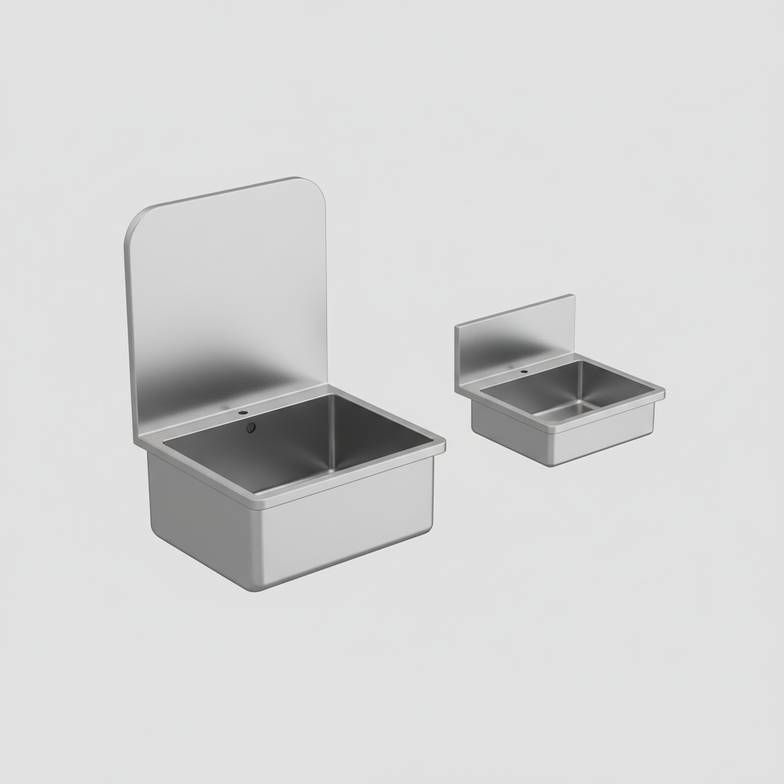
- Surgical Scrub Sinks: These are specialized stations for the procedural scrubbing required before entering a sterile environment like an operating room. The user scrubs their hands and arms up to the elbows. Therefore, the sink's design is important for helping prevent re-contamination. A true scrub sink typically features:
- A deep, angled basin: To contain water and minimize splashing.
- A high splashback panel: To protect the wall and reduce the chance of contaminated water splashing back onto the user's sterile scrubs.
- Rounded internal corners: To make cleaning more effective and reduce areas where contaminants can linger.
Simply ordering a "deep sink" for a surgical area may not provide the necessary anti-splash geometry, making it unfit for its intended purpose. The first step is to match the sink's design to the user's action.
What Stainless Steel Grade Should You Specify?
The belief that all stainless steel is immune to rust in a hospital setting is a costly misjudgment. The choice of material grade should be determined by the cleaning chemicals the sink will be exposed to daily.
- SS304 Stainless Steel: This is the industry standard and is suitable for many applications with general cleaning. It offers good durability at a more accessible cost.
- SS316 Stainless Steel: This grade contains molybdenum, which significantly increases its resistance to corrosion from chlorides and harsh disinfectants. For departments like a Central Sterile Services Department (CSSD), laboratories, or any area where aggressive cleaning agents are used, SS316 may be a more durable long-term investment.
While SS316 costs more upfront, specifying it for high-exposure areas can help reduce the risk of premature pitting and corrosion that might occur with SS304, avoiding the need for early replacement. Before you finalize an order, confirm the cleaning protocols for the intended department. If you are unsure, specifying SS316 for sensitive areas is often the more prudent decision.
How to Choose Between Sensor, Knee, or Foot Activation
Hands-free activation is a common feature for many hospital sinks, but the best method depends on more than just modern aesthetics. It's a practical trade-off between reliability, maintenance, and your facility's specific conditions.
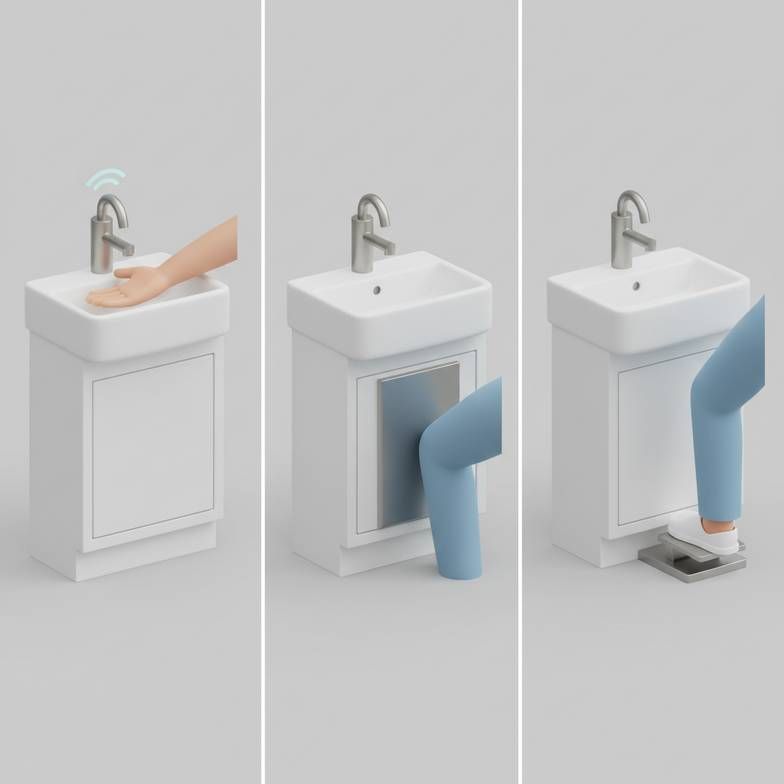
- Sensor Faucets: These offer a touch-free experience that many prefer. However, they require a power source. Before specifying a sensor sink, you must confirm if a reliable AC power outlet is available at the installation point. If not, you'll need to consider battery-powered models, which require regular maintenance, or budget for new electrical work.
- Knee or Foot Pedals: These mechanical systems are extremely reliable and require no power. They are robust, easy to use, and have fewer components that can fail. For high-traffic areas or facilities that prefer simpler maintenance, a knee- or foot-operated sink is often a more practical and dependable choice than a poorly installed or maintained sensor system.
The best activation method balances hygiene goals with the reality of your installation site and your team's ability to maintain the equipment.
The Sink Is a System: A Checklist for a Complete Specification
Comparing sink quotations based on the final price is often a mistake. A "cheaper" sink is frequently just a bare basin, while a more expensive quote may include all the essential components for a safe and complete installation.
To make a fair comparison, you should confirm you are quoting for the same complete system. A thermostatic mixing valve (TMV), for example, is not an optional luxury. It's a key component for safety that blends hot and cold water to a preset temperature, helping to reduce the risk of scalding injuries to patients and staff. If a quote doesn't explicitly list it, assume it's not included.
Use this checklist to build a detailed specification or to audit the quotations you receive.
Hospital Sink Specification Checklist
| Specification Area | Decision to Make | What to Confirm in the Quotation |
|---|---|---|
| 1. Sink Type & Use | Is it for surgical scrub or general handwash? | Check that the quote specifies a sink with appropriate basin depth and anti-splash geometry for scrub areas. |
| 2. Material Grade | Which stainless steel is needed for your cleaning protocol? | Confirm the quote and material sheet explicitly state "SS304" or corrosion-resistant "SS316". |
| 3. Water Activation | Sensor, knee, or foot pedal? | Confirm the activation method and, for sensors, if the power source (AC or battery) is specified. |
| 4. Water Temperature | How will water be controlled for safety? | Confirm that a Thermostatic Mixing Valve (TMV) is listed as an included item, not an optional extra. |
| 5. Included Accessories | What other components are part of the system? | Check if the faucet/spout and drain assembly are clearly listed as included. |
| 6. Installation Details | How will the sink be mounted? | Verify the sink's dimensions and mounting type (e.g., wall-mount) against your site plans and wall structure. |
How to Prepare an Inquiry That Gets Comparable Quotes
To avoid confusing and incomplete quotations, provide potential suppliers with a clear and detailed inquiry. An experienced supplier will ask these questions anyway; providing the information upfront saves time and helps you get quotes that are accurate and truly comparable.
A vague request like "price for 5 scrub sinks" will only result in guesswork. A strong inquiry forces every supplier to quote on the exact same basis, revealing the true cost of a complete, fit-for-purpose system. If a supplier provides a price without asking for these details, it's a red flag that their quotation may be incomplete.
Before you contact suppliers, prepare the following information for each type of sink your project requires:
1. The Department and Intended Use: (e.g., Surgical Scrub-up, ICU Handwash, CSSD Utility). 2. The Required Sink Type and Stations: (e.g., Single-station scrub sink, 3-station clinical sink). 3. Your Preferred Activation Method: (Sensor, knee, or foot pedal) and confirmation of power availability if a sensor is chosen. 4. Material Requirement, if known: (e.g., "Our cleaning protocol requires SS316 for the CSSD area"). 5. A list of required system components: State clearly that a thermostatic mixing valve must be included in the price. 6. A simple drawing or dimensions of the installation space, especially for multi-station units.
Sending this complete package allows a supplier to provide a thorough quotation that meets your facility's real-world needs and helps avoid costly surprises during installation.
Written by
CareFurnex Team
CareFurnex Team shares practical knowledge about hospital beds, patient room furniture, medical trolleys, clinic furniture, and healthcare facility procurement for international B2B buyers.
Related Products
Examination Tables
Medical exam tables for clinics, hospitals, treatment rooms, and healthcare facilities.
View product
Waiting Chairs
Clinic waiting chairs and bench seating for public reception and patient waiting areas.
View product
Hospital Beds
General-purpose patient beds for inpatient wards and standard hospital rooms.
View product