
Struggling to respond to a vague customer inquiry for a "medical cart"? It’s a frustratingly common problem that makes accurate quoting feel like a guessing game and puts your entire deal at risk. The core issue is that your customer is asking the wrong question, leading to a comparison based on price alone. The solution is to reframe the conversation and clarify that a medical cart isn't a single item, but a whole category of specialized equipment.
A medical cart is a mobile, wheeled workstation specifically designed and configured to support a particular workflow within a healthcare environment. It is not a generic product but a functional tool categorized by its intended use, such as an emergency cart, anesthesia cart, or medication cart. Its true value lies in having the right drawers, accessories, and materials for a specific department's needs.
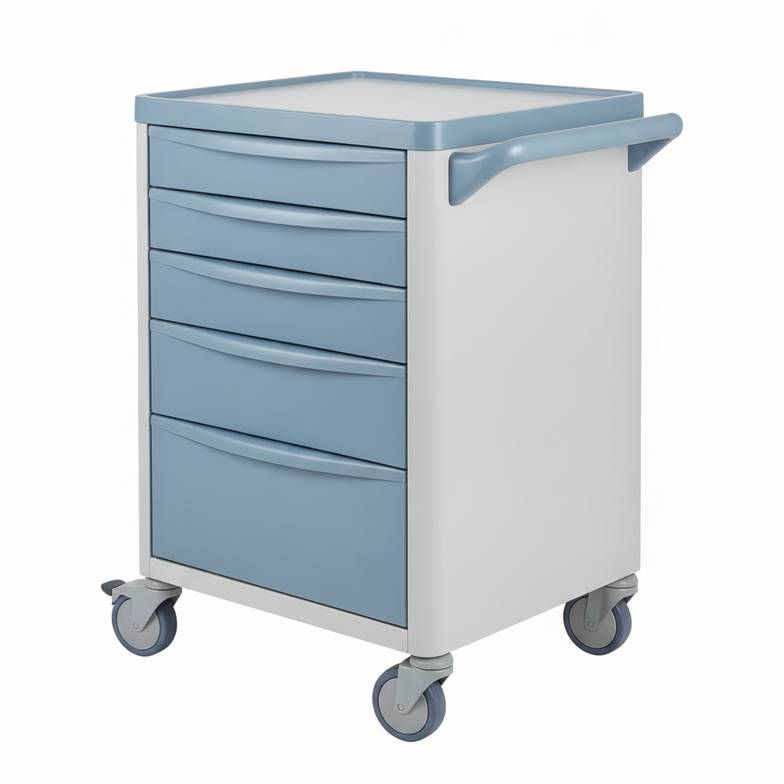
Now, understanding this definition is the first step. The real question for distributors and importers like you is how to use this knowledge to reduce sourcing risks and win better projects. Let's dive into how you can shift the conversation from a generic product to a specific, value-driven solution.
Why is a Vague "Medical Cart" Inquiry a Problem for Distributors?
Let's be honest, you've received that email before. The one that just says, "Please send quote for 20 medical carts." What do you do? You feel trapped between quoting your cheapest model and risking an unfair comparison, or asking clarifying questions and potentially losing the impatient buyer to a faster competitor.
A vague inquiry is a huge red flag. It almost always leads to incorrect price comparisons, mismatched product specifications for the real-world application, and an unhappy end-user hospital. For a distributor, this is a major business risk that can damage your reputation and profitability.
The "Bad Inquiry" Trap
Based on my experience helping our distributor partners, this is how a deal goes wrong. A hospital procurement officer, possibly unfamiliar with the nuances, sends a tender request for "medical carts" to ten suppliers. Nine of them immediately quote their most basic, low-cost treatment trolley because it has the lowest price tag.
You, however, know that a hospital needs different carts for different departments. You reply asking, "Are these for the Emergency Room, the Operating Theater, or general patient wards?" By the time you get a response (if you get one at all), the buyer has already anchored on the low prices from your competitors. Your technically correct but higher-priced quote for an actual emergency cart now looks expensive and out of touch. You lose the deal, and the hospital ends up with a cart that can't do the job it was hired for.
Shifting the Conversation from Price to Function
The only way to win in this scenario is to change the conversation from the very beginning. You must establish yourself as an expert, not just a box-mover. The moment you receive a vague inquiry, your first response should be geared toward education.
I always advise our partners to reply with something like: "We can certainly help with that. To ensure we quote the correct model for your needs, could you let me know which department will be using these carts? The requirements can differ significantly."
This simple question immediately reframes the discussion. It shows you care about getting it right and opens the door to explain the functional differences. Here’s a simple mental checklist we use:
- Emergency Room (ER)? They need a designated Emergency Cart (or "Crash Cart").
- Operating Room (OR)? They need a specialized Anesthesia Cart.
- General Patient Wards? They will likely need a Medication Cart for dispensing drugs or a general Treatment Cart for procedures like changing dressings.
- Central Sterile Services Department (CSSD)? They require durable, easy-to-sterilize Stainless Steel Carts.
By guiding your client through this logic, you move the discussion away from "who is cheapest" and toward "what is the right tool for the job." This positions you as a valuable consultant and helps the client make a smarter purchasing decision.
How Can You Classify a Medical Cart for Your Catalog?
Building a product catalog or preparing for a large hospital tender can feel overwhelming with the sheer number of medical cart models available. If you don't structure your offerings in a clear and logical way, your sales team won't be able to make confident recommendations, and your customers will just see a confusing wall of similar-looking products.
The most effective method is to organize your medical cart offerings by their primary function and the department they serve. Classify each cart by its core purpose: Emergency Carts, Anesthesia Carts, Medication Carts, and general-purpose Treatment Carts. This functional taxonomy creates a simple framework for sales, marketing, and tender responses.
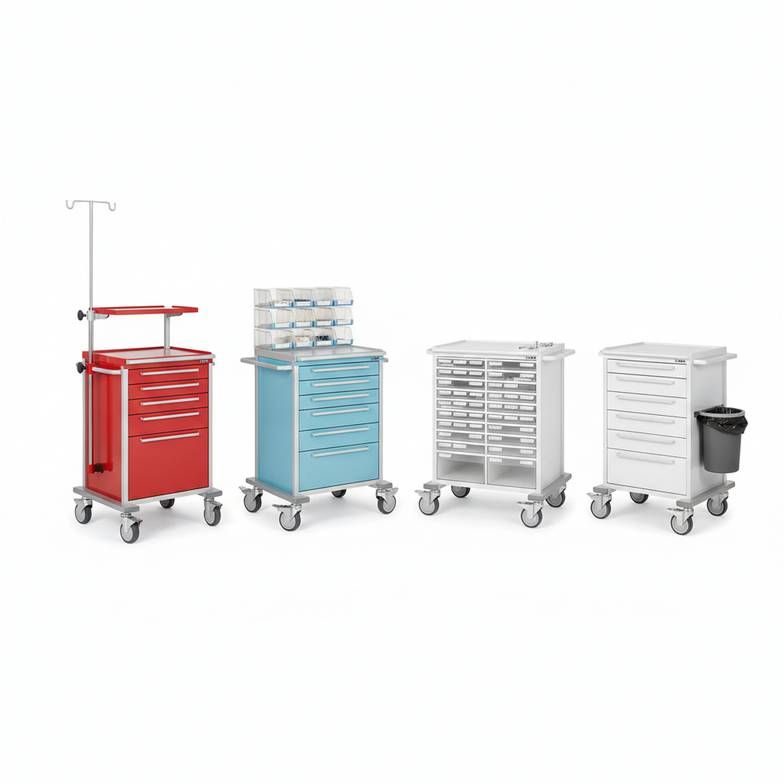
A Functional Taxonomy for Your Business
Think of this as a "good, better, best" model, but based on specialization instead of just quality. It helps you and your customer quickly narrow down the options. Here is a breakdown of the main categories we see in hospital projects.
Emergency Carts (Crash Carts)
These are designed for one thing: responding to life-threatening situations like cardiac arrest. Speed and organization are everything. They must contain all necessary equipment in a predictable layout. Key features include a central seal lock (so staff can see if it's been used), a defibrillator shelf, an IV pole, an oxygen tank holder, and a cardiac board for CPR. The drawers are usually labeled and stocked for specific emergency protocols (e.g., airway, circulation).
Anesthesia Carts
Used exclusively in the operating room, these carts are all about organizing a large number of small items—medications, syringes, and ampoules. Their defining feature is often a series of small, transparent tilting bins or drawer dividers. This allows the anesthesiologist to see and access dozens of different drugs quickly. A secure, lockable drawer for controlled substances is also a standard requirement.
Medication Carts
These are the workhorses of the patient wards. Nurses use them to distribute scheduled medications to multiple patients. The design focuses on security and workflow efficiency. You'll often see them with multiple smaller drawers, sometimes one per patient, which can be individually locked. They need to be easy to push down long corridors, so quiet, smooth-rolling casters are a must.
Treatment Carts (Procedure Carts)
This is the most basic and versatile category. They are used for general tasks like wound care, drawing blood, or transporting simple supplies. They typically feature a simple flat top work surface, a few drawers for storing gauze and tools, and a waste bin. This is the model most often quoted in response to a vague "medical cart" inquiry, but as you can see, it's completely unsuitable for an emergency or surgical setting.
To make it even clearer, here is a simple comparison table:
| Cart Type | Primary Use | Key Accessories | Drawer Configuration | Locking System |
|---|---|---|---|---|
| Emergency Cart | Life support, CPR | Defibrillator shelf, IV pole, O2 holder | Labeled, procedure-specific | Central Seal Lock |
| Anesthesia Cart | Surgical anesthesia | Tilting bins, sharps container | Many small, divided drawers | Central Key Lock |
| Medication Cart | Routine drug dispensing | Patient-specific bins | Multiple small, individual drawers | Individual or Central Lock |
| Treatment Cart | General procedures | Waste bin, side rail | A few large, general drawers | Optional / Simple Key Lock |
What Details Differentiate a Cheap Medical Cart from a Professional One?
Your client is looking at two carts on your website. They look almost identical, but one is priced at $300 and the other at $700. Naturally, they assume the more expensive one is a ripoff. You're left struggling to explain the hidden value, which can be tough without concrete examples.
The price of a professional medical cart is justified by critical, purpose-built components that a cheaper model simply doesn't have. Details like medical-grade silent casters, robust central locking systems, and durable drawer slides directly impact staff efficiency, product longevity, and even patient safety. Understanding these differences is your key to justifying value.
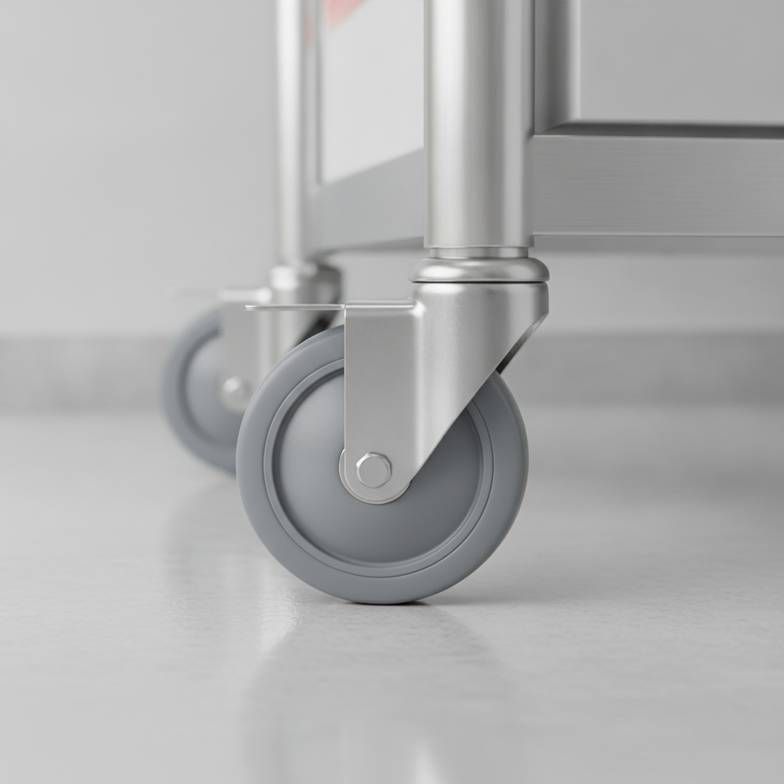
Casters: The Unsung Heroes of Mobility
The wheels are one of the most important yet overlooked components. A cheap cart might use standard 75mm or 100mm casters made of hard plastic, similar to what you'd find on office furniture. A professional medical cart will use 125mm medical-grade silent casters.
- Why does this matter?
- Noise Reduction: The softer TPR (Thermoplastic Rubber) material on medical-grade casters rolls almost silently, which is crucial in quiet hospital wards, especially at night.
- Ease of Use: A larger wheel diameter makes it significantly easier to roll the cart over thresholds, elevator gaps, and different flooring surfaces. This reduces physical strain on nurses who are pushing these carts all day.
- Stability: Professional carts often feature a central braking system. Instead of having to lock two separate wheels with your foot, you can lock all four wheels with a single press of a pedal. It's faster, more secure, and safer.
Locking Systems: More Than Just Security
As we discussed, locking systems are tailored to the cart's function. But the quality of the lock itself also varies. A basic treatment cart might have a flimsy cam lock on a single drawer. An emergency or medication cart needs something far more robust. The central locking system on a quality medical cart uses a single key turn to engage metal rods that secure every drawer at once. This saves valuable time for staff and provides real security for controlled substances. For crash carts, the disposable plastic seal lock is a brilliant, low-tech solution. A quick glance tells staff if the cart is fully stocked and ready for an emergency—if the seal is broken, it needs to be restocked immediately.
Body Construction and Drawer Quality
Look closer at the drawers. Cheaper carts use basic drawer slides that are noisy and may not extend fully. A professional cart uses soft-close, full-extension ball-bearing slides.
- Soft-close prevents drawers from slamming shut, reducing noise and wear and tear.
- Full-extension means the drawer pulls all the way out, so staff can see and access items at the very back without having to rummage around.
The body construction matters, too. Many carts use a combination of a powder-coated steel frame for strength and an ABS plastic body. A quality cart will have a one-piece molded ABS top with raised edges to contain spills and integrated push handles. This is easier to clean and more ergonomic than bolt-on handles.
By explaining these specific, tangible differences, you can confidently show a client why the $700 cart is not just "more expensive" but a better long-term investment that will perform reliably for years.
Is an ABS or Stainless Steel Medical Cart Better?
Buyers often come in with a fixed idea about materials. A common one I hear is, "It's for a hospital, so it must be stainless steel, right?" This assumption can lead them to specify the wrong cart for the job—one that is too heavy, unnecessarily expensive, or poorly suited to the department's daily workflow.
The truth is, neither material is universally "better." ABS plastic is perfect for general and emergency use carts, while stainless steel is essential for sterile environments like the Operating Room. The best material depends entirely on where and how the cart will be used and, just as importantly, how it will be cleaned.
The Case for ABS Plastic Carts
Most of the functional carts we've discussed—emergency, anesthesia, and medication carts—are primarily constructed from ABS plastic bodies on a steel or aluminum frame. There are very good reasons for this.
- Lightweight and Maneuverable: ABS is significantly lighter than steel. This makes the cart easier for nurses to start, stop, and steer through crowded hospital hallways.
- Impact Resistance: ABS is tough and slightly flexible, so it can handle the inevitable bumps and collisions of a busy hospital environment without denting or chipping its finish.
- Color-Coding: The plastic can be easily manufactured in different colors. This is a huge functional advantage. It's why you see red emergency carts and blue anesthesia carts—it allows for instant visual identification from across a room.
- Integrated Design: ABS can be molded into complex shapes. This allows for features like integrated push handles, raised-edge tops to contain spills, and built-in accessory mounts. This one-piece design has fewer seams and crevices, making it faster and easier to wipe down and clean.
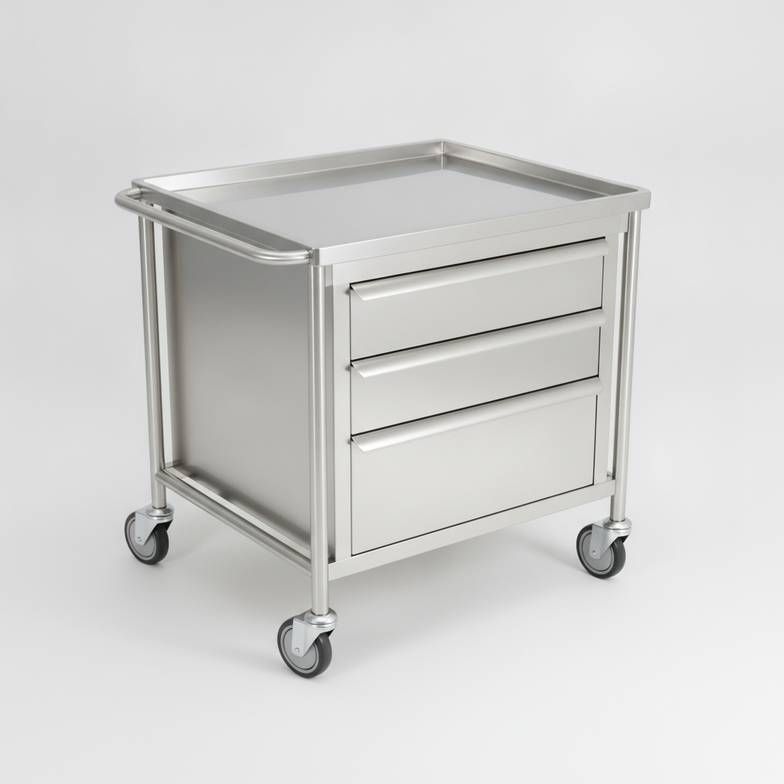
The Unbeatable Case for Stainless Steel Carts
So, when is stainless steel the right choice? When sterility is the absolute top priority. Stainless steel (specifically 304-grade) is the undisputed king for environments like the Operating Room, CSSD, and laboratories.
- Non-Porous Surface: The primary reason is that stainless steel is non-porous. This means there are no microscopic holes or cracks where bacteria and other pathogens can hide from cleaning agents.
- Corrosion Resistance: These departments use harsh chemical sterilants and disinfectants that would degrade plastic or powder-coated surfaces over time. 304-grade stainless steel is formulated to resist corrosion from these aggressive chemicals, ensuring a long and sterile service life.
- Durability: While heavier, stainless steel is incredibly strong and resistant to heat and physical damage, making it ideal for transporting heavy instrument trays or case carts.
The key takeaway for you and your client is this: match the material to the cleaning protocol. For general wipe-downs on a ward, ABS is perfect. For full chemical sterilization, you must use stainless steel.
| Feature | ABS Plastic Cart | 304 Stainless Steel Cart |
|---|---|---|
| Ideal Environment | ER, Wards, Clinics | OR, CSSD, Labs |
| Weight | Lightweight, easy to push | Heavy, very robust |
| Cost | More affordable | Higher initial investment |
| Cleaning | Good for general disinfectants | Excellent for harsh chemical sterilants |
| Design | Easy to color-code, molded features | Simple, functional design |
Frequently Asked Questions
What is the difference between a medical cart and a medical trolley?
The terms "medical cart" and "medical trolley" are largely interchangeable and refer to the same type of equipment. "Cart" is more common in American English, while "trolley" is more prevalent in British English. The most important thing is not the name but specifying the function—e.g., "emergency cart" or "anesthesia trolley."
How do I choose the right size for a medical cart?
Consider two factors: the physical space in the department and the volume of supplies required. A smaller, more compact cart is better suited for tight clinic rooms. A larger cart with more storage capacity will be necessary for a busy, high-traffic patient ward. Always confirm the external dimensions (Length x Width x Height) before ordering.
What is a central locking system on a medical cart?
A central locking system enables a user to lock or unlock all drawers on the cart at the same time with a single key turn or lever. This is a major time-saver for nursing staff compared to locking each drawer individually and provides superior security for medications and sensitive supplies.
Why are accessories for an emergency cart so important?
In a medical emergency like a cardiac arrest, every second is critical. Having essential equipment like an IV pole, a shelf for the defibrillator, a holder for an oxygen tank, and a CPR board attached directly to the cart ensures everything is in one place and ready for immediate use. These accessories aren't optional; they are vital for the cart to fulfill its life-saving purpose.
Conclusion
The next time you receive an inquiry for a "medical cart," you'll know what to do. The key is to stop thinking of it as a single product and start treating it as a specialized category. By guiding your client to ask the right question—"What specific function does this cart need to perform?"—you change the entire dynamic of the sale. Understanding how to classify carts by function, recognizing the small details that create real value, and matching materials to the department's needs are what separate a simple reseller from a trusted procurement partner. A well-specified medical cart doesn't just win you the order; it provides a genuine solution that supports healthcare workers and ensures patient safety.
As a B2B project support partner, our goal at CareFurnex is to help you navigate these specifications with confidence. If you are preparing a tender response, building out your product catalog, or need help matching the right products to a hospital project, send us your requirements. We're here to help you select and deliver the right healthcare furniture solutions for your clients.
Written by
CareFurnex Team
CareFurnex Team shares practical knowledge about hospital beds, patient room furniture, medical trolleys, clinic furniture, and healthcare facility procurement for international B2B buyers.
Related Products
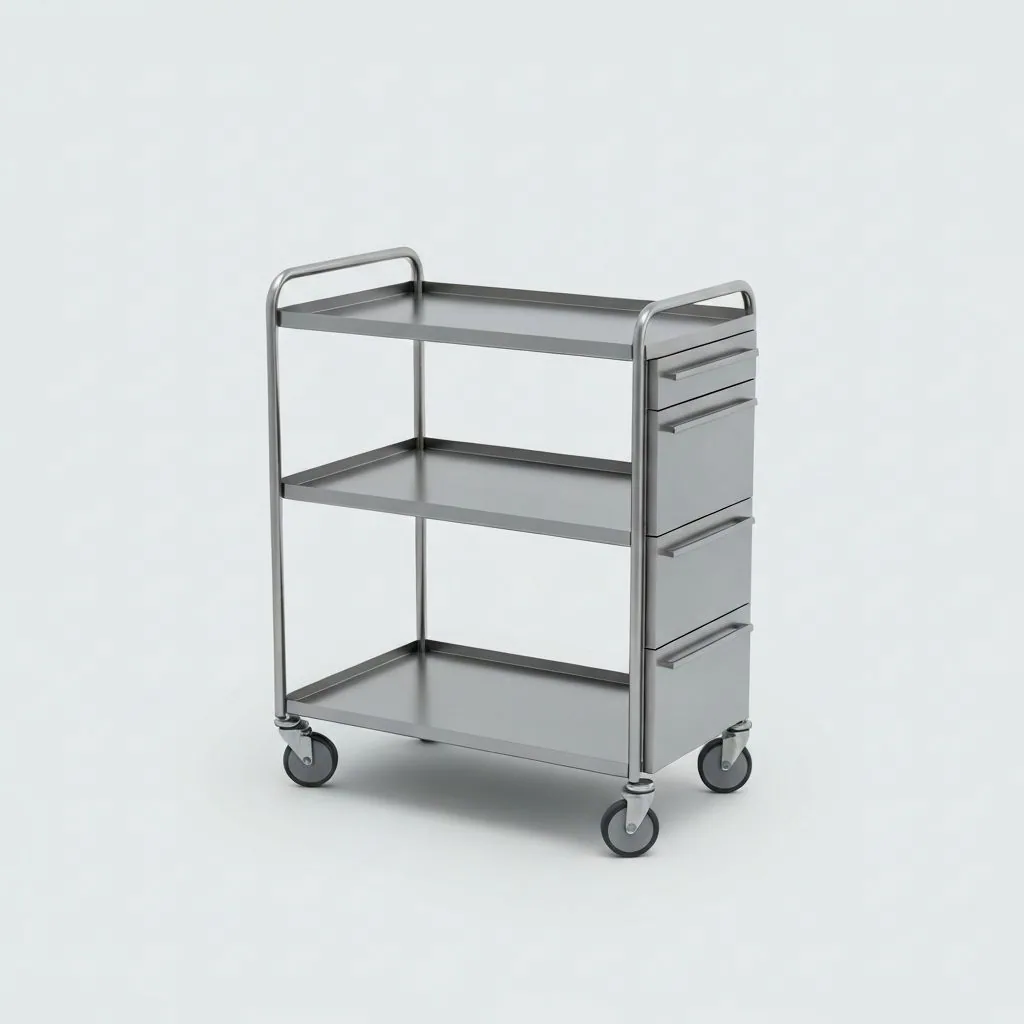
Medical Trolleys
Mobile carts for nursing rounds, treatment supplies, medicines, and clinical tools.
View product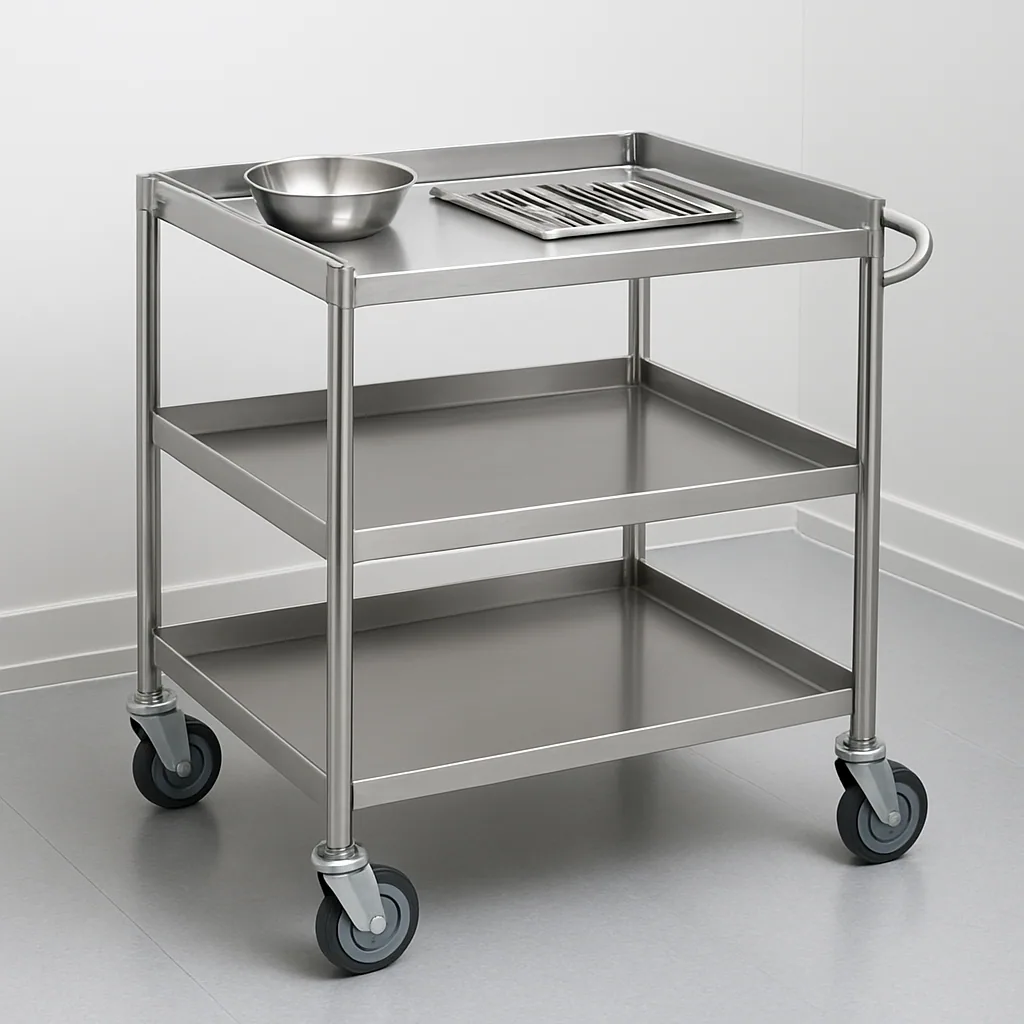
Treatment Carts
Practical treatment carts with drawers, storage space, and smooth mobility for clinical use.
View product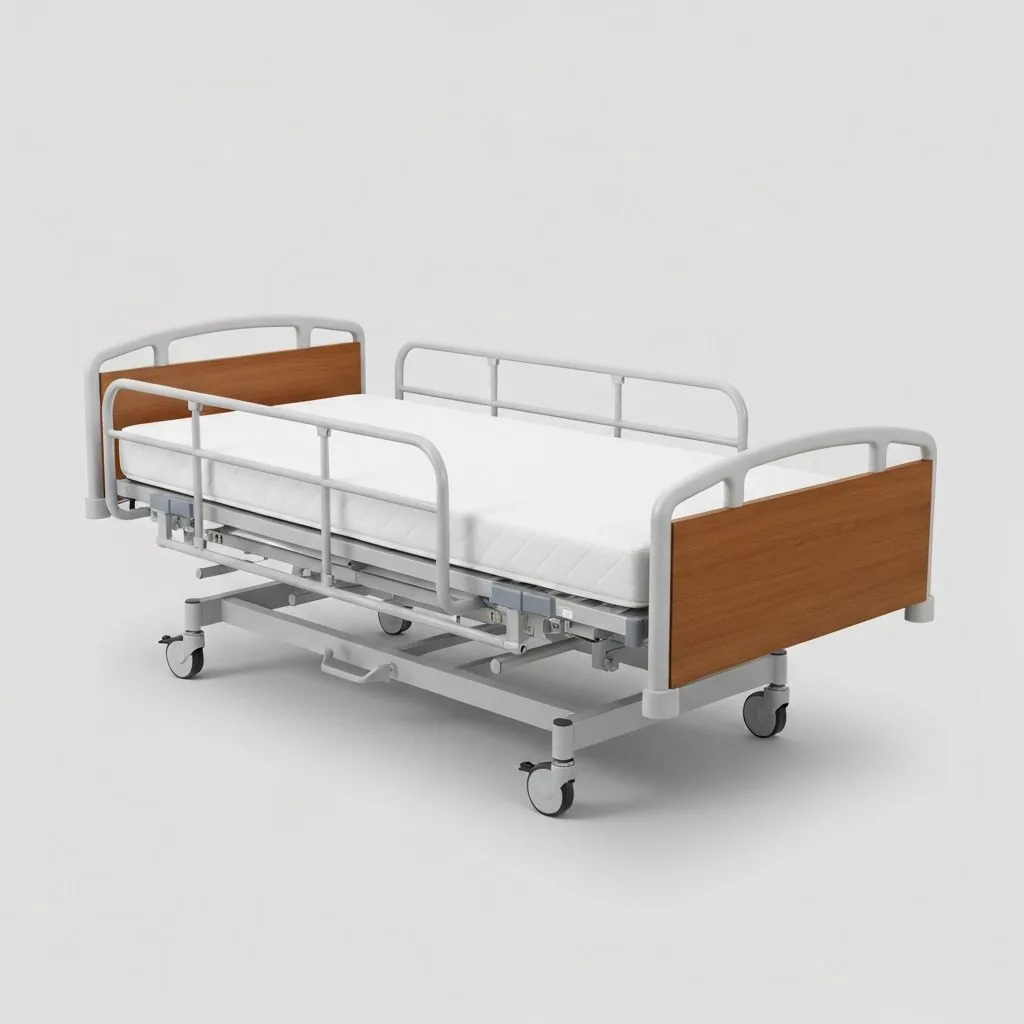
Hospital Beds
General-purpose patient beds for inpatient wards and standard hospital rooms.
View product