
Feeling the pressure to stock up on hospital furniture? You might see overbed tables as a simple, high-volume product. But I’ve seen this assumption lead to disaster for distributors who end up with a warehouse full of tables that don't fit under their customers' beds. The key to avoiding this expensive mistake lies in understanding the critical details of overbed table base clearance before you place your order.
Overbed table base clearance is the vertical space between the floor and the bottom of the overbed table's base frame, which must be high enough to slide under a hospital bed. Critically, buyers must confirm this clearance not just against the bed's under-frame height but also against potential obstacles like caster brake pedals, central locking bars, and motors on electric or ICU beds.
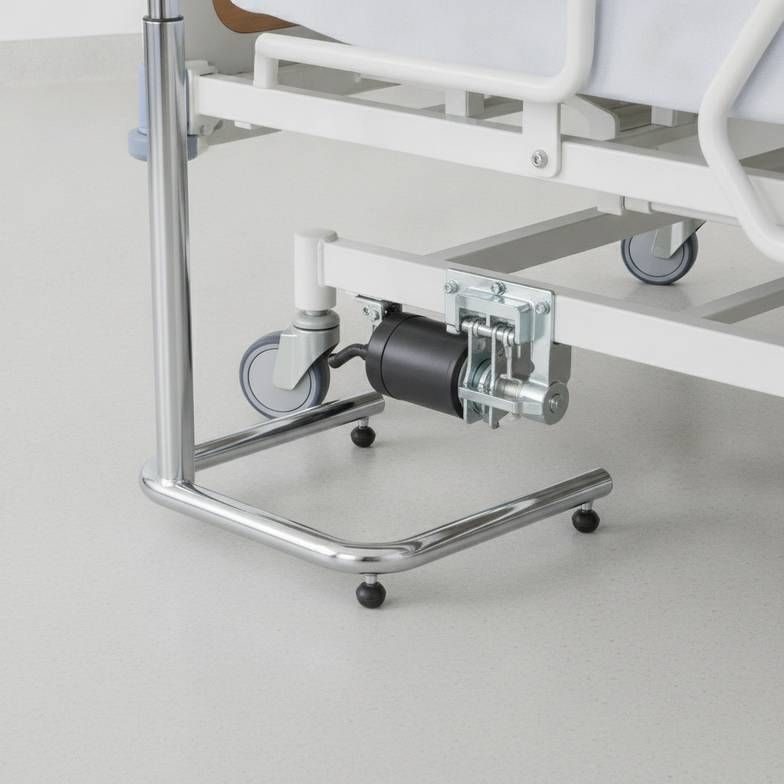
Just knowing the height in centimeters isn't enough. The real issue is compatibility in a complex environment. Let's dive into the hidden risks that spec sheets don't mention and explore a process to protect your investment.
Why Is Overbed Table Base Clearance a Critical Business Risk?
You might think a few centimeters of clearance is a minor technical detail. But what if that single detail determines whether your entire shipment of overbed tables sells or sits in your warehouse as dead stock? The financial stakes are much higher than you think.
This isn't just a technical problem; it's a financial one. A mismatch between the table base and the hospital beds in your market leads directly to unsellable inventory, tying up your capital, damaging your reputation, and forcing you to pay for storage on products that generate zero revenue.

I remember getting a call from a new distributor a while back. He was in a panic. He had just received his first container of 400 overbed tables, a significant investment for his growing business. The problem? His biggest customer, a chain of local nursing homes, tried them out and found the tables couldn't slide under their fleet of electric beds. The table base was colliding with the bed's central brake mechanism.
He was stuck. His initial excitement turned into a financial nightmare. His capital was tied up in inventory he couldn't move. He had two terrible choices: sell them at a massive loss or pay to store them indefinitely. This is the real-world consequence of overlooking overbed table base clearance.
For a distributor or importer, your business model relies on procuring inventory that has broad market compatibility. You need products that work for the widest possible range of end-users. When you buy overbed tables, you're not buying for one specific project; you're buying for stock. An incompatibility issue like this means:
- Dead Stock and Tied-Up Capital: This is the most immediate pain. Money that should be cycling through your business is now frozen in your warehouse.
- Damaged Reputation: When you supply a product that doesn't work, it makes you look unprofessional. Your customers lose trust, and you might lose future opportunities.
- Wasted Logistics Costs: You paid for manufacturing, shipping, customs, and inland freight, all for a product you can't sell.
- Limited Market: Your "universal" overbed table is now a niche product that only fits a small subset of beds, drastically shrinking your potential customer base.
This is why I always tell my clients to treat base clearance not as a simple line on a spec sheet, but as a critical business risk that needs active verification.
What Hidden Obstacles Affect Real-World Overbed Table Base Clearance?
Your supplier's spec sheet says the base height is 10cm, and you know the target hospital bed has 12cm of space under its frame. It should be a perfect fit, right? Unfortunately, the spec sheet doesn't tell the whole story. I've seen many procurement managers fall into this trap.
Real-world compatibility is about more than a simple height dimension. True overbed table base clearance is often blocked by hidden obstacles that are never mentioned in product catalogs. The most common culprits are the hospital bed's caster brake pedals, central locking system bars, and the motors or actuators on electric beds.
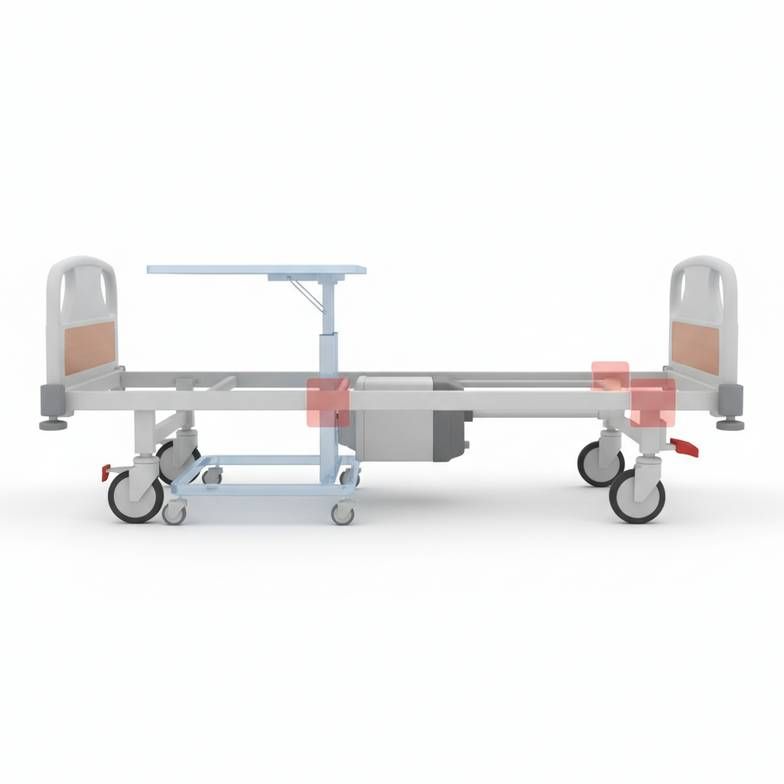
Let's break down these expert traps that you absolutely need to be aware of. These are the details that separate a successful procurement from a costly mistake.
The Caster Brake Pedal Trap
On many hospital beds, especially more advanced models, each caster has its own brake pedal. Even when the brake is not engaged, the pedal itself can stick out from the side of the wheel, creating a low-hanging obstruction. A U-shaped or H-shaped table base that is wide enough to fit around the wheel might still collide with the pedal. I have seen bases get stuck on, or even damage, these pedals.
The Central Locking System Problem
More and more hospital beds, particularly ICU and electric models, feature a central braking system. This system is controlled by a single pedal (or a few linked pedals) that locks all four wheels at once. To make this work, there is often a metal bar or linkage running underneath the bed, connecting the casters. This bar can be a complete barrier for a "U" shaped table base, which is designed to slide straight in. An "H" shaped base might be able to straddle this bar, but only if the width between the legs of the "H" is sufficient.
Electric Bed Motors and Actuators
Electric hospital beds use motors and actuators for height adjustment, backrest articulation, and Trendelenburg positioning. Where are these motors often located? Directly under the bed frame, right in the path of an incoming overbed table. A low-profile base might clear the main frame but get blocked by a bulky motor housing. This is one of the most common and frustrating sources of incompatibility.
To make this clearer, let's compare how different table bases handle these obstacles:
| Base Type | Pros for Clearance | Cons for Clearance |
|---|---|---|
| U-Shaped Base | Simple, often cost-effective. | Easily blocked by central locking bars and motors. |
| H-Shaped Base | Can potentially straddle a central locking bar. | The crossbar of the "H" can still hit low obstacles. The width must be correct. |
| C-Shaped Base | Offers more room for maneuver as it approaches from the side. | Can be less stable; still needs to clear casters and brake pedals. |
| Low-Profile Base | Designed to be very low to the ground (e.g., < 9 cm). | May still be defeated by very low brake pedals or floor-level mechanisms. |
The takeaway here is that you cannot rely on a single dimension. You must consider the entire under-bed environment.
How Can You Verify Compatibility and Ensure Correct Overbed Table Base Clearance?
Are you tired of the guesswork and the constant worry of ordering the wrong products? Relying on a single clearance number from a supplier's catalog is a gamble you can't afford to take. The good news is there is a much safer, more reliable way to procure.
The best way to verify compatibility and ensure correct overbed table base clearance is to adopt a simple verification process. You need to provide your supplier with photos, diagrams, or model numbers of the hospital beds common in your market and explicitly ask them to confirm the fit. This shifts the responsibility and leverages their expertise.
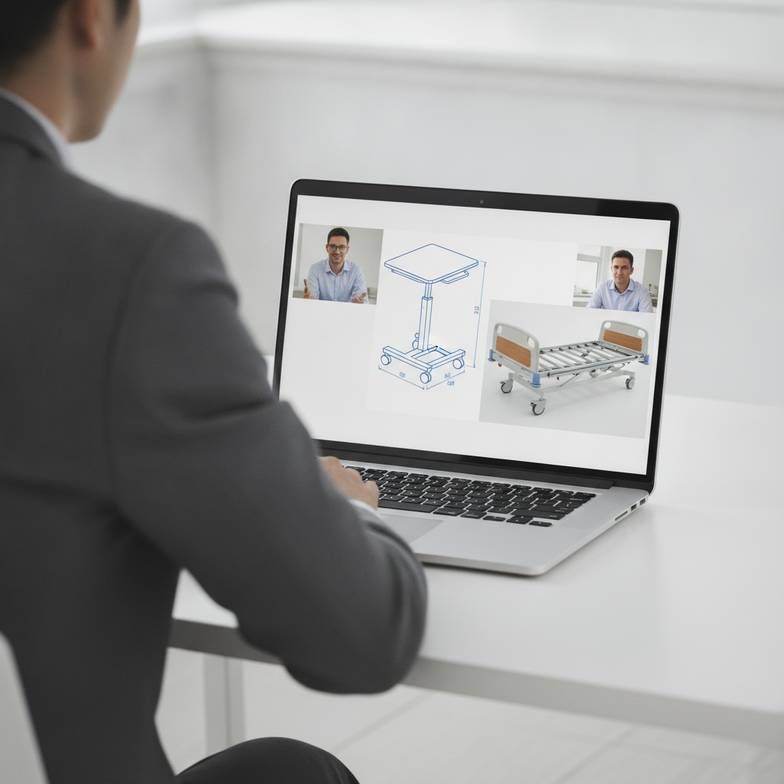
Instead of just taking orders, your supplier becomes a partner in solving a critical problem. Here at CareFurnex, this is a standard part of our consultation process because it prevents after-sales headaches for everyone involved. It's a process you can and should demand from any supplier.
Here's how to do it:
Step 1: Gather Your Intelligence
Before you even contact a supplier, do your homework. Your goal is to understand the "use environment" where your tables will end up.
- Collect Photos: If you can, get clear photos of the hospital beds your key customers use. The most important shot is a side-on view that clearly shows the space under the bed, including the casters, brakes, and any visible mechanisms.
- Identify Bed Models: If you can find out the brand and model numbers of the most popular beds in your region (e.g., Hill-Rom, Stryker, or local brands), that information is golden.
- Measure If Possible: If you have access to a bed, take two key measurements: the height from the floor to the bottom of the bed frame, and the height from the floor to the lowest hanging part (which is often a brake pedal or motor housing).
Step 2: Ask the Right Questions
When you approach a supplier, you are now armed with information. This changes the entire conversation.
- Don't Ask: "What is the base height?"
- Do Ask: "Here are photos and the under-bed clearance details for the most common hospital beds in my market. Can you please confirm that your model XYZ overbed table will fit without any issues? Specifically, can you confirm it will clear the caster brake pedals and any central locking bars?"
This question does two things: it shows you are a professional buyer who understands the risks, and it places the responsibility on the supplier to give you a definitive "yes" or "no."
Step 3: Request Proof
A good supplier should be able to provide you with more than just a verbal confirmation.
- Request a Diagram: Ask them to provide a technical drawing of their table base with all critical dimensions clearly marked.
- Ask for a Mock-up: For a large order, it's reasonable to ask the supplier to superimpose their base drawing onto a photo or diagram of your target bed to visually confirm the fit.
- Video Confirmation: In some cases, if they have access to a similar bed, a short video showing the table sliding underneath is the ultimate proof.
By following this process, you transform procurement from a passive act of ordering to an active process of risk mitigation. You're not just buying a product; you're buying a compatible solution for your customers.
Frequently Asked Questions
What is a typical low-profile base height for an overbed table?
A typical low-profile base height is around 9 cm (or 3.5 inches). However, this number alone is not enough. You must always verify it against the specific obstacles under the target hospital beds, such as brake pedals and central locking bars, which can be lower than the main frame.
Can I use the same overbed table for a manual bed and an ICU bed?
Not always. Manual beds generally have much more under-bed clearance and fewer obstructions. ICU beds, on the other hand, are complex, often featuring central locking systems, multiple motors, and bulkier frames. It's crucial to select an overbed table with a base designed to navigate these specific obstacles.
Does the shape of the overbed table base (H-base vs. U-base) matter for clearance?
Yes, it matters significantly. A U-shaped base slides straight in but can be completely blocked by a central locking bar. An H-shaped base has a better chance of straddling such a bar, but the width between the legs of the 'H' must be adequate. The choice depends entirely on the design of the beds it will be used with.
What should I do if I've already ordered tables that don't fit?
This is a tough situation. First, see if there's a niche market you can sell them to—perhaps clinics or facilities with simpler beds. Modifying the tables is risky and can void warranties. The most common, though painful, solution is to liquidate the stock at a discount to recover some of your capital and treat it as a costly but valuable lesson.
Conclusion
We've seen that overbed table base clearance is far more than a simple dimension on a specification sheet—it's a critical business variable that can determine the success or failure of your inventory investment. The common assumption of universal compatibility is a myth that leads to dead stock and financial loss. The real-world obstacles are hidden details like caster brake pedals, central locking bars, and motors that generic catalogs never show. By moving beyond a single number and adopting a proactive verification process with your supplier, you can effectively mitigate this risk.
If you are sourcing medical furniture and want to partner with a supplier who understands these critical details, we can help. At CareFurnex, we work with distributors and project contractors to confirm specifications and ensure the healthcare furniture you source is practical, compatible, and ready for your market. Contact us to discuss your next project.
Written by
CareFurnex Team
CareFurnex Team shares practical knowledge about hospital beds, patient room furniture, medical trolleys, clinic furniture, and healthcare facility procurement for international B2B buyers.
Related Products
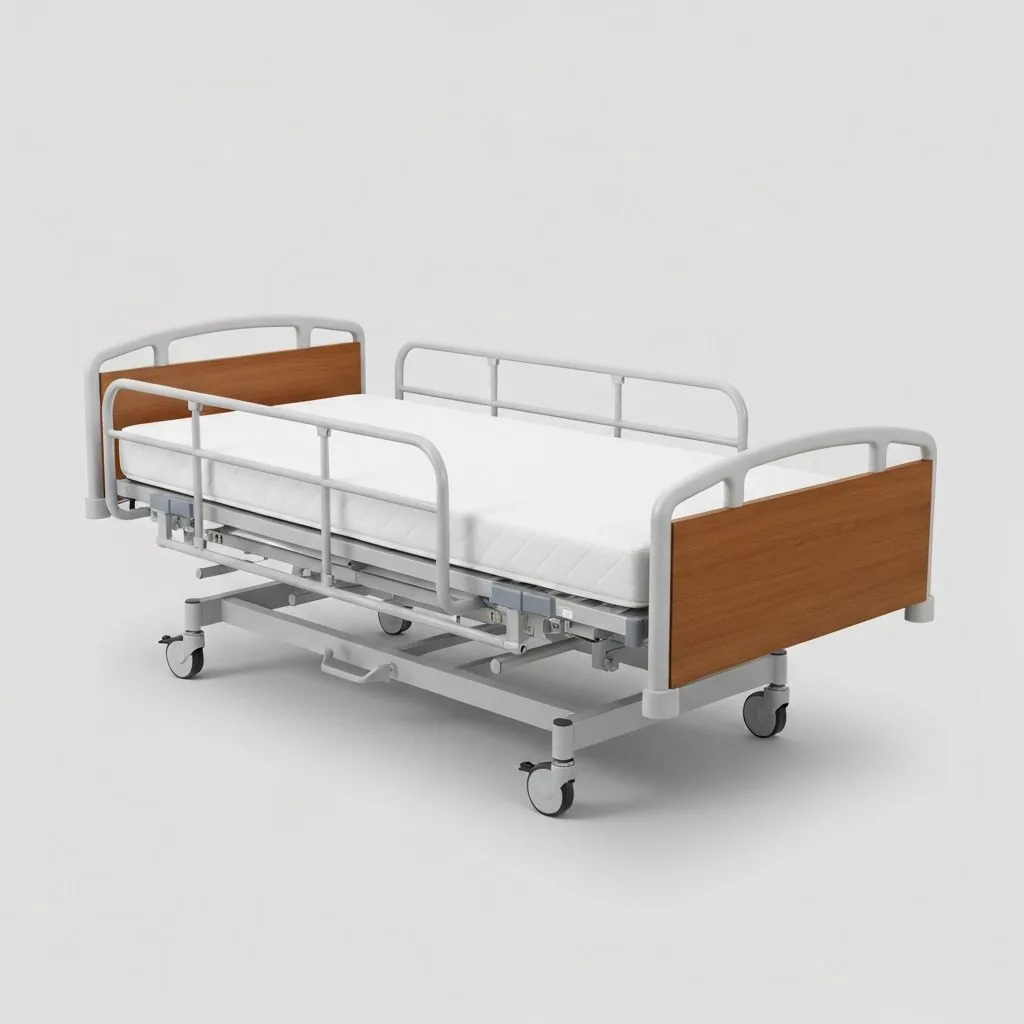
Hospital Beds
General-purpose patient beds for inpatient wards and standard hospital rooms.
View productElectric Hospital Beds
Motorized multi-function beds with electric height, backrest, and leg adjustment options.
View product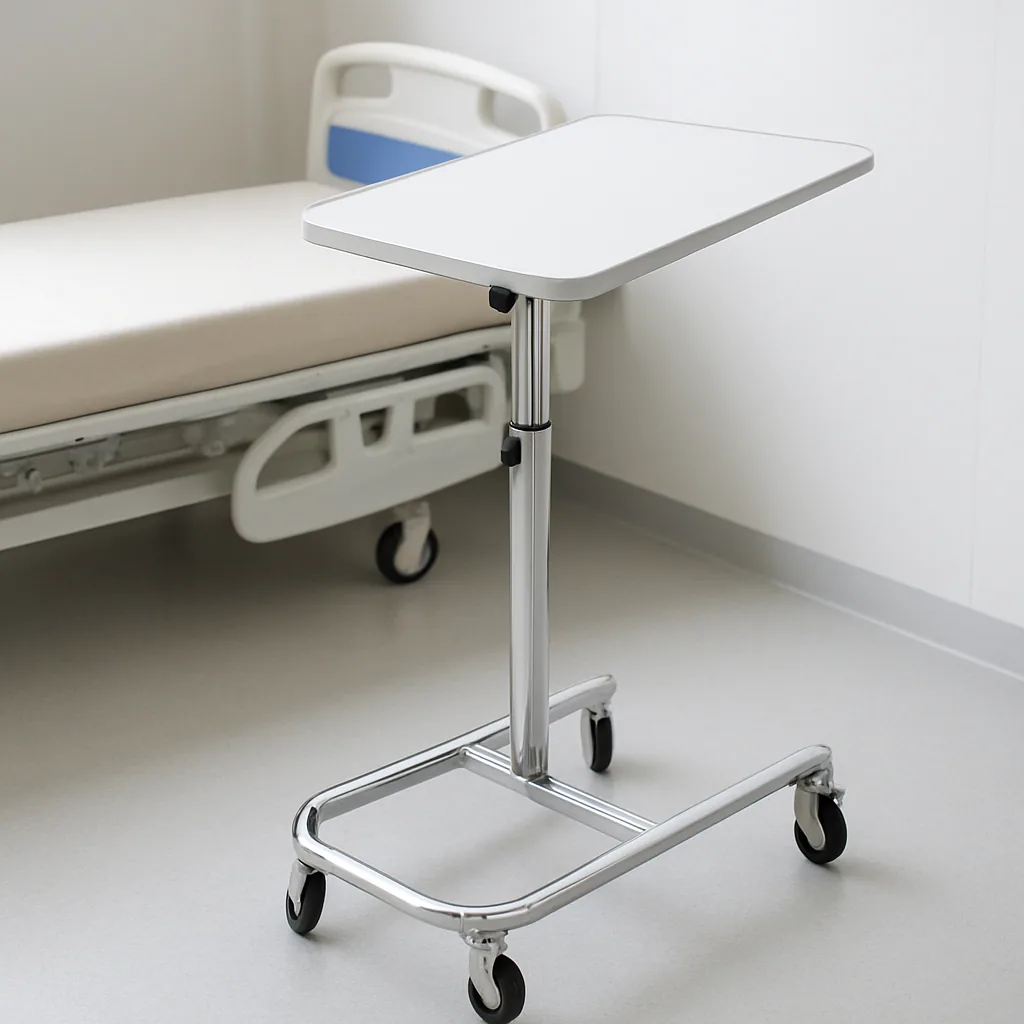
Overbed Tables
Height-adjustable tables for patient meals, reading, and bedside activities.
View product