
A new hospital ward project often starts with a simple list: 20 beds, 20 cabinets, 10 trolleys. You send this list to a few suppliers, but the quotations that come back have wildly different total prices. One quote is 30% higher than another, and a third seems to be missing items.
This confusion is a common and frustrating experience for procurement managers. The problem isn't necessarily the suppliers; it's the initial request. A simple list of item names is not a project plan. It leaves too much open to interpretation, forcing suppliers to make assumptions about function, configuration, and logistics.
To effectively plan furniture for a new hospital ward, first translate your floor plan into a room-by-room list. Next, define the specific function of each room to create a detailed item list, confirm key configurations like bed functions or trolley accessories, and always request packing details and shipping volume (CBM) to accurately forecast the total project cost.
From our side as a supplier, when we receive a request for a "total project cost" based only on a floor plan, our first step isn't to create a quote. It's to help the buyer build a functional, room-by-room item list. This upfront planning is what separates a smooth procurement process from one filled with budget surprises and operational mismatches.
Where do I start if I only have a hospital ward floor plan?
Your floor plan is the correct starting point, but don't send it to suppliers asking for a price. Instead, use it to create a simple, structured list of all the functional spaces in your new ward.
This is a clerical task, not a technical one. Go through the plan and count every room type. Your list will look something like this:
- Single-Patient Rooms: 12
- Multi-Patient Rooms (4 beds): 2
- Nurse Station: 1
- Clean Utility Room: 1
- Soiled Utility Room: 1
- Medication Room: 1
- Staff Lounge: 1
This simple list of spaces is the foundation of your entire project plan. It moves you from a drawing to a concrete scope. This helps confirm no area is forgotten and provides the structure for the next, more detailed step.
How do I turn a room list into a detailed furniture plan?
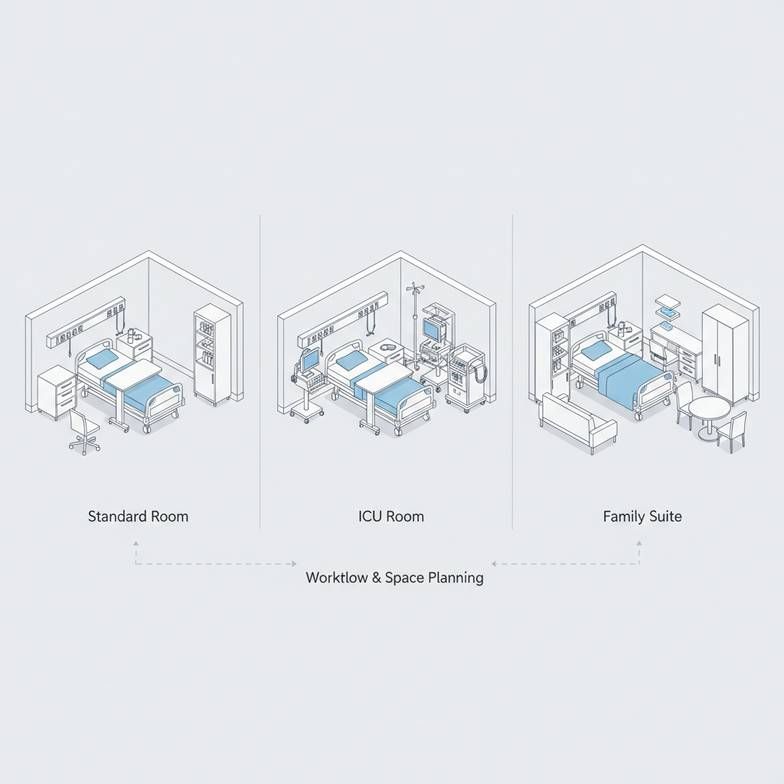
With your room list complete, you can now assign furniture items and quantities to each space. This is where you must consider the specific workflow and function of each room. If possible, involve clinical staff or department heads in this stage.
Work through your room list one by one. For example:
- For each of the 12 Single-Patient Rooms: You might need 1 hospital bed, 1 bedside cabinet, 1 overbed table, and 1 patient chair.
- For the 1 Nurse Station: You might plan for 2 workstations (desk + chair), 1 lockable filing cabinet, and 1 large information board.
- For the 1 Clean Utility Room: You will likely need stainless steel shelving units and a medical supply trolley.
The goal is to create a comprehensive Bill of Quantities. A simple spreadsheet with columns for "Room Type," "Furniture Item," and "Quantity" is perfect for this. This document, not the floor plan, becomes the master list for your project.

What key specifications affect furniture function and cost?
Assuming a "hospital bed" or "medical trolley" has a standard meaning is a frequent cause of non-comparable quotes. For your most important or high-quantity items, you should define the 1-3 features that are most important for function and patient care.
This doesn't require deep technical knowledge. It's about defining the primary use.
- Hospital Beds: Is a manual or electric bed needed? How many functions (e.g., 2-function for back and leg adjustment, 3-function adds height adjustment)? Are side rails required? These choices directly impact cost and patient care.
- Medical Trolleys: Specify the intended use. A "dressing trolley" has a different drawer and accessory layout than an "emergency/crash cart" or an "anesthesia trolley." The function dictates the configuration.
- Bedside Cabinets: What material is needed? ABS plastic is a lightweight material with a smooth surface, while powder-coated steel offers different durability. You should consider which material properties best align with your facility's cleaning protocols. Do you need a lock for patient belongings?
- Accessories: Items like mattresses, IV poles, and chart holders are often quoted as optional. Your plan should clarify whether these need to be included in the price or quoted separately.
Adding a "Key Specifications" column to your spreadsheet for these important items makes your request clearer and helps suppliers bid on the same basis.
What project details besides unit price influence my total budget?
Focusing only on the per-item price is one of the biggest budgeting mistakes in project procurement. For furniture, two logistical factors can dramatically impact your total landed cost: shipping volume (CBM) and on-site assembly.
1. Packing Method: Furniture can be shipped fully-assembled or knock-down (KD).
- Fully-Assembled: Ready to use on arrival but takes up significant container space, increasing freight costs. A fully-assembled medical trolley has a high CBM.
- Knock-Down (KD): Shipped flat-packed. This greatly reduces the CBM and shipping cost but requires on-site labor, tools, and time for assembly. A KD hospital bed has a much lower CBM than an assembled one.
2. Total Shipping Volume (CBM): Your total CBM determines how many shipping containers you need. A supplier who quotes a low unit price but uses inefficient, bulky packing may end up being more expensive after freight costs are calculated.
A serious project quotation should include the packing method and an estimated total CBM. If a quote is missing this information, you cannot accurately calculate your final project cost.
How can I prepare a request that gets me comparable quotes?
By following the steps above, you have already created most of what you need for a professional Request for Quotation (RFQ). The final step is to consolidate this information into a clear, organized document. This signals to suppliers that you are a serious project buyer and makes it easy for them to provide the detailed response you need.
Your RFQ should be built around a clear table or checklist. This structure makes it simple to compare the responses you receive.
Project Planning Checklist
| Planning Step | What the Buyer Prepares | What to Confirm with the Supplier |
|---|---|---|
| 1. Scope Definition | A list of all room types and their quantities (e.g., 15 Patient Rooms, 1 Nurse Station). | Does the supplier have experience outfitting these specific types of hospital spaces? |
| 2. Itemization | A detailed, room-by-room list of furniture items and quantities. | Can the supplier provide all product categories on the list, or are there gaps? |
| 3. Specification | Key functional requirements for priority items (e.g., Bed: 3-function electric; Cabinet: steel, lockable). | Does the supplier's quotation clearly match these specifications for each line item? |
| 4. Accessories | A list of required accessories for each item (e.g., mattress, IV pole, side rails). | Are these accessories included in the unit price or quoted separately as optional items? |
| 5. Logistics | Destination port and any preference for assembled vs. knock-down (KD) packing. | What is the packing method, CBM per item, total CBM for the project, and estimated lead time? |
When you send this structured request, you are no longer just asking for "a price." You are asking for a complete project proposal that gives you the data needed for a true, like-for-like comparison.
Preparing Your Project Inquiry
To receive a useful and comparable quotation for your hospital ward project, preparing your plan first is a practical step. A well-structured inquiry helps us provide a detailed proposal that aligns with your budget and operational needs.
Before requesting a quote, please try to prepare the following:
- Your room-by-room furniture list with quantities.
- The key functional specifications for important items like beds and trolleys.
- A list of any essential accessories (e.g., mattresses, IV poles) that must be included.
- Your destination port or city for logistics planning.
Sending this information allows us to build a comprehensive quotation that includes the unit prices, configuration details, and the packing and shipping volume data you need for accurate project budgeting.
Written by
CareFurnex Team
CareFurnex Team shares practical knowledge about hospital beds, patient room furniture, medical trolleys, clinic furniture, and healthcare facility procurement for international B2B buyers.
Related Products

Ward Furniture
Complete ward furniture options for patient rooms and hospital care areas.
View product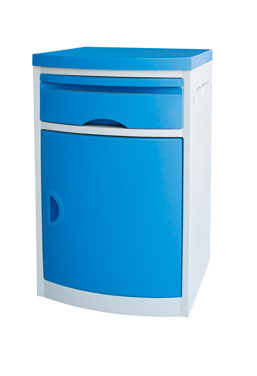
Hospital Bedside Cabinets
This ABS hospital bedside cabinet has a blue top, an upper drawer and a lower door within a light-colored body. Its stated size is 480 × 480 × 760 mm, giving buyers a defined overall footprint for ward furniture planning.
View product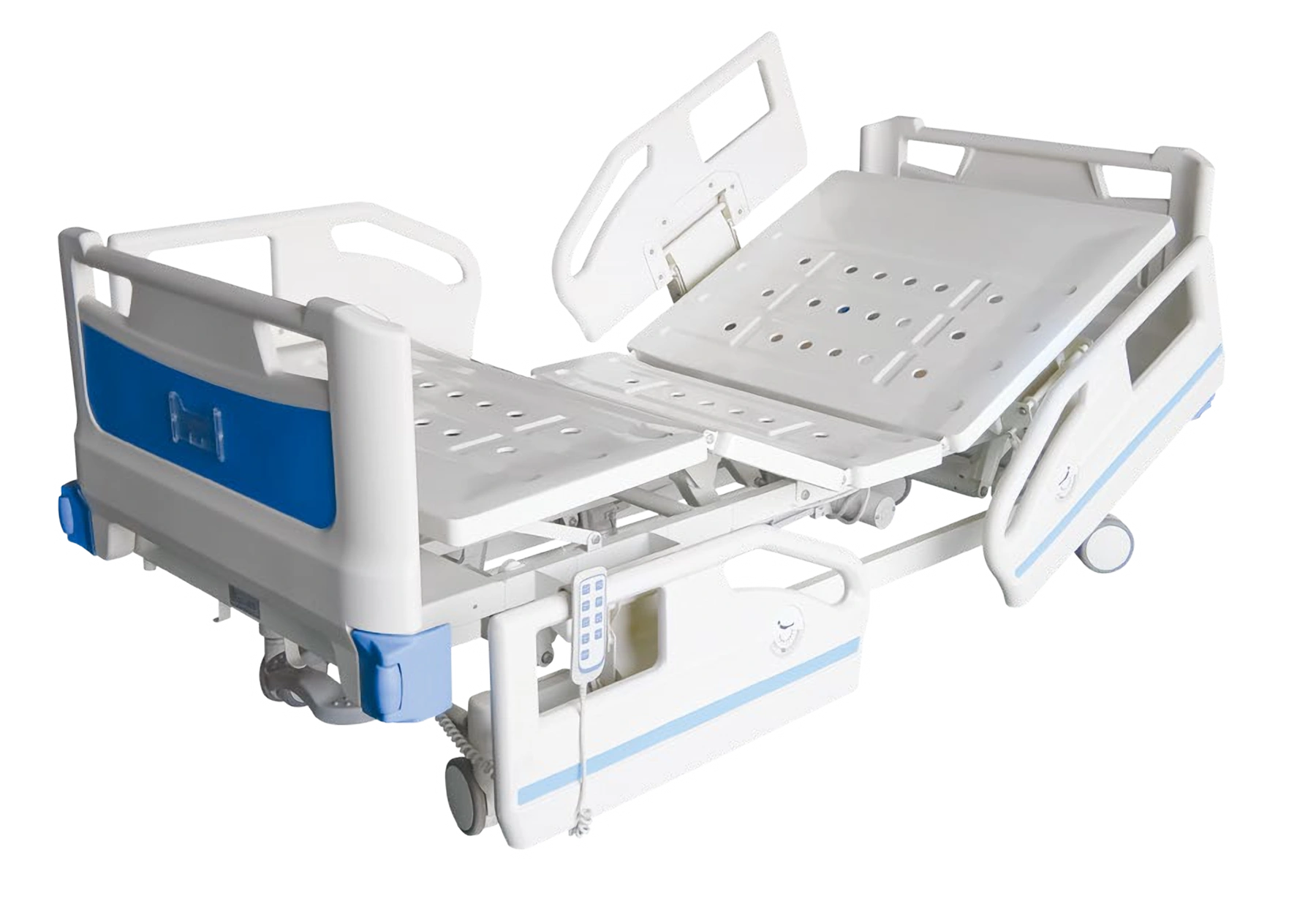
Hospital Beds
General-purpose patient beds for inpatient wards and standard hospital rooms.
View product