
When sourcing hospital beds for a healthcare project, many buyers start by comparing product photos and unit prices. This approach often leads to procurement problems: beds that are unsuitable for the care environment, missing accessories, unexpected shipping costs, and project delays.
The lowest price on a quotation rarely tells the whole story. Two hospital beds that look similar online can have different functions, safety features, packaging, and supplier support levels. Choosing the wrong one can impact everything from caregiver workload to your project's final budget.
To choose hospital beds for a healthcare project, first match the bed type to the care area, then confirm functions, accessories, safety details, packaging, shipping volume, trade terms, and supplier support before comparing prices.
The best hospital bed for a project is not always the cheapest or most advanced model. It is the bed that matches the care environment, arrives complete and undamaged, and can be supported clearly by the supplier from quotation to delivery.
How Should You Match Hospital Beds to Different Healthcare Project Areas?
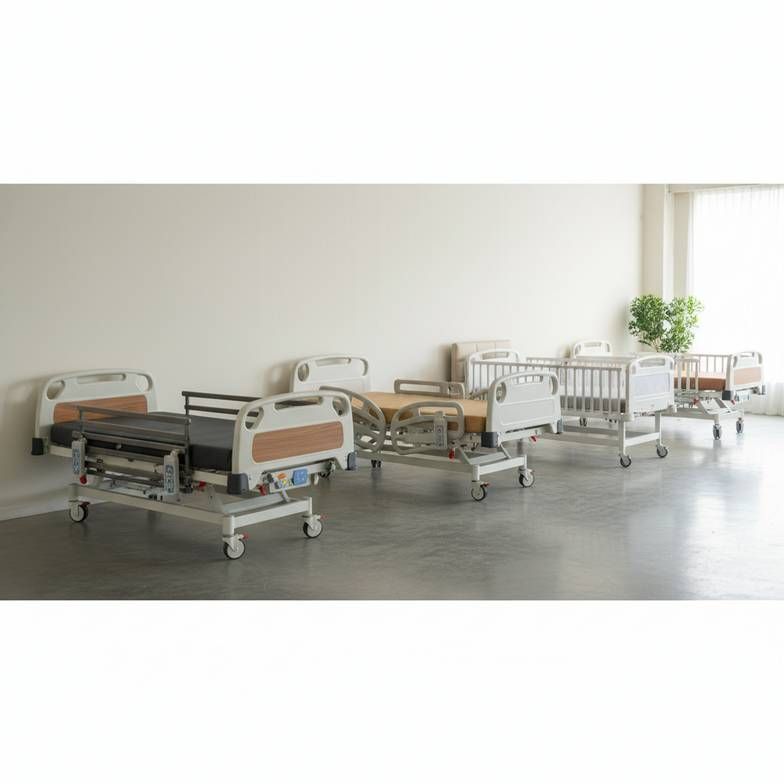
Start by dividing your project into specific use areas before selecting bed models. A single "standard" hospital bed model rarely fits the needs of an entire healthcare facility. Choosing one model for every room may simplify the initial purchase order, but it can create daily-use problems and user complaints after installation.
From the supplier side, we often see buyers request a single price for "100 hospital beds." A more effective inquiry specifies quantities for different departments, such as general wards, recovery rooms, or elderly care units. This allows a supplier to recommend more suitable and cost-effective options.
Before you request quotes, create a project list that maps bed quantities to specific care scenarios. This prevents over-spending on advanced features where they aren't needed and ensures high-demand areas get the functionality they require. For most healthcare projects, specifying for suitability creates better long-term value than standardizing for simplicity.
Use this matrix as a planning tool to organize your project requirements.
Hospital Bed Selection Matrix by Project Area
| Project Area | Patient/Care Scenario | Bed Type to Consider | Key Functions to Confirm | Accessories to Plan | Buyer Question |
|---|---|---|---|---|---|
| General Ward | Standard patient care | Manual hospital bed or suitable patient bed | Basic adjustment, side rails, wheels, brakes | Mattress, IV pole, bedside cabinet | Is manual adjustment enough for daily use? |
| Clinic Room | Short-term patient use or examination | Basic patient bed or manual hospital bed | Mobility, safety rails, easy cleaning | Mattress, small storage if needed | What level of adjustment is really needed? |
| Nursing Home Room | Elderly care and daily support | Manual or electric bed depending on care level | Adjustment convenience, safety rails, mobility | Mattress, overbed table, storage furniture | How often will caregivers need to adjust the bed? |
| Higher-Care Area | More frequent repositioning or patient handling | Electric hospital bed may be considered | Electric functions, brakes, caregiver operation | Mattress, IV pole, related ward furniture | Is the added function worth the budget and maintenance? |
| Recovery Room | Comfort and repeated care for long-stay patients | Manual or electric based on care demand | Comfort, adjustment, safety, durability | Mattress, bedside cabinet, overbed table | What daily care workflow should the bed support? |
Note: This table is a simplified planning example. The final choice should be based on your facility's specific protocols and care standards.
Should You Choose Manual Hospital Beds or Electric Hospital Beds?
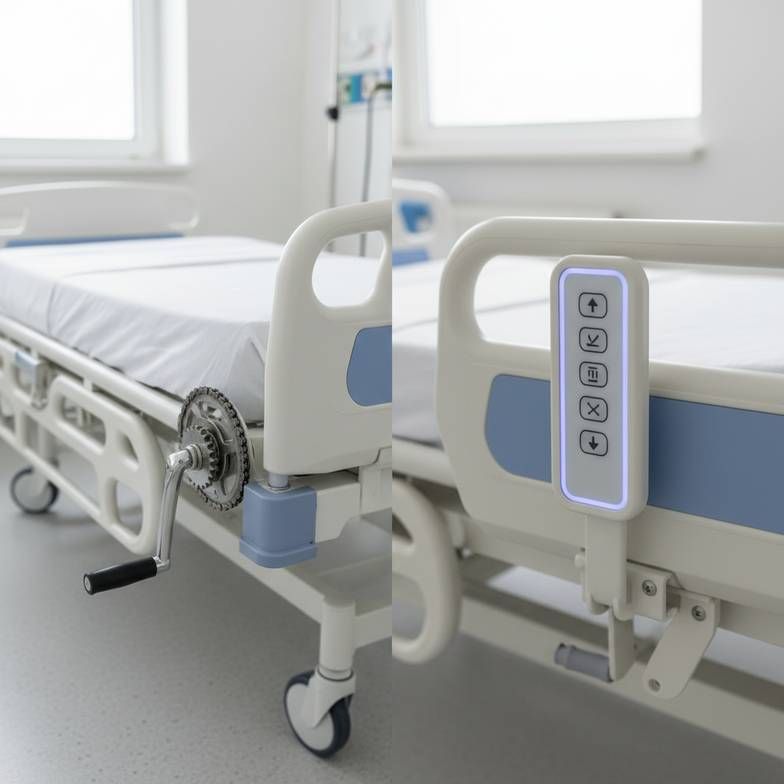
Choose between manual and electric beds based on caregiver workload and frequency of adjustment, not just on price. Many buyers treat this as a simple budget decision, but the real trade-off is between initial cost and long-term operational efficiency.
Manual hospital beds, adjusted with hand cranks, are more affordable and require less maintenance. They can be a good choice for general wards where adjustments are infrequent. However, in an environment where nurses constantly reposition patients, relying on manual cranks can increase physical strain and take up valuable time.
From a supplier's perspective, I've seen projects where the initial savings on manual beds were later offset by caregiver complaints and slower workflows. Conversely, buying fully electric beds for every room can be an unnecessary expense if the advanced functions are rarely used.
The most effective step is to consult with your clinical or care staff to understand how often beds will be adjusted. The decision isn't just "manual vs. electric," but "where does electric adjustment provide a real return in efficiency and ergonomics?"
- Choose manual hospital beds when budget control is a primary driver and the care environment involves basic, infrequent adjustments.
- Consider electric hospital beds when patient repositioning is frequent, as this can reduce caregiver workload and improve patient comfort.
- For large projects, check your team's maintenance capacity and the supplier's spare parts support before committing to a large number of electric beds.
What Specifications and Safety Details Should You Confirm Before Comparing Quotations?
To get comparable quotations, you must provide every potential supplier with the same clear specifications. Sending a vague inquiry like "price for 50 hospital beds" results in quotes based on different assumptions, making a fair comparison impossible. One supplier might quote a basic model, while another quotes a higher-spec version.
Two beds that look alike in a photo can have different frame structures, mattress platforms, side rail mechanisms, and caster (wheel) quality. When a buyer receives quotes with a wide price variance, it's almost always because the specifications aren't aligned. A low price might be for a bed with simple drop-down side rails, while a higher price is for a model with safer, multi-stage collapsible rails.
Use this checklist to confirm key details with each supplier before you compare prices. The risk of not doing this is choosing a supplier based on a low price that hides a lower-quality configuration, leading to problems after delivery.
Pre-Quotation Confirmation Checklist
Ask each supplier to confirm these details for their quoted model:
- Bed Type: Is it manual or electric? How many functions (e.g., back-rest, leg-rest, height adjustment)?
- Included Components: Are the head/foot boards, side rails, and casters with brakes included as standard?
- Mattress: Is a mattress included, or is it quoted separately?
- Accessories: Are items like an IV pole or lifting pole standard, optional, or excluded?
- Packaging: What kind of packaging is included? Is it suitable for export or just local delivery?
- Trade Term: Is the price based on EXW (Ex-Works), FOB (Free On Board), or another term?
Only when you have these answers from all suppliers can you begin to compare their offers fairly.
Which Accessories and Ward Furniture Should Be Planned Together With Hospital Beds?
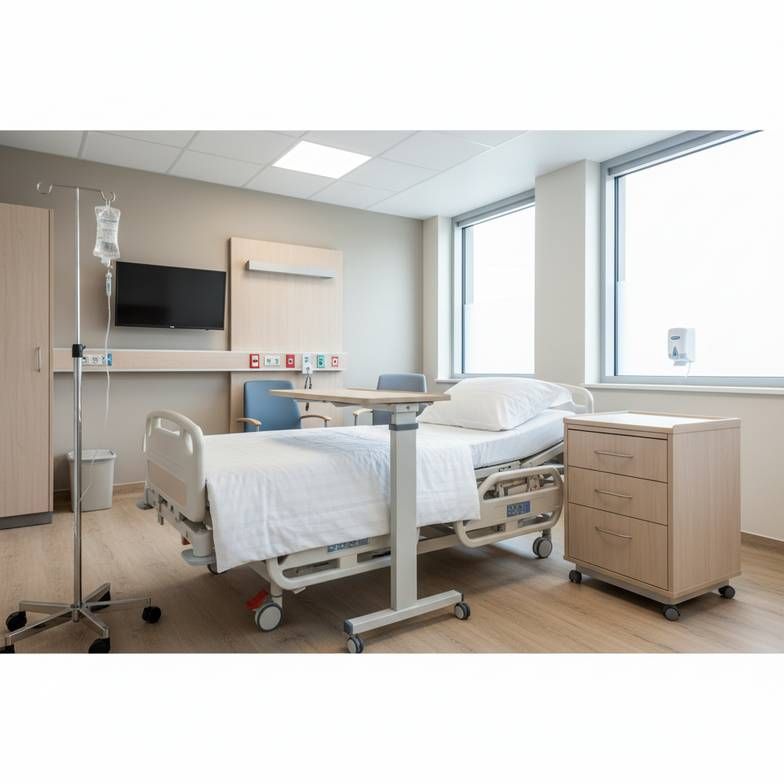
Plan for accessories and related ward furniture from the beginning, not as an afterthought. A hospital bed is part of a complete patient room system that includes a mattress, bedside cabinet, overbed table, and often an IV pole.
I have seen many projects where the buyer focused only on the beds, leaving accessories for later. This often leads to several problems: a second shipment is needed, increasing freight costs; the accessories don't match the beds; and the entire ward setup is delayed. In a large project order, a "small" missing accessory like an IV pole can render hundreds of beds incomplete.
The best practice is to prepare a complete requirement list for the entire patient room or ward area. Thinking of it as a "ward furniture project" instead of just a "bed purchase" will save you time and money.
Accessory & Ward Furniture Planning Checklist
Before confirming your bed order, check if you also need to plan for:
- [ ] Mattresses (of appropriate type and size)
- [ ] IV poles
- [ ] Bedside cabinets
- [ ] Overbed tables
- [ ] Medical trolleys for the ward
- [ ] Patient room storage or chairs
- [ ] How all accessories will be packed and labeled for easy distribution on-site
How Do Export Packaging, Loading Volume, and Trade Terms Affect the Real Cost?
For importers and project buyers, the real cost of a hospital bed is its landed cost, not its unit price. Hospital beds are bulky and heavy. The way they are packed has a direct impact on shipping damage, freight costs, and the number of units you can fit in a container.
A supplier might offer a slightly lower unit price but use weaker packaging. From our experience on the factory side, export packaging is critical. A bed frame that gets scratched or a plastic board that cracks during transit creates immediate repair or replacement costs for the buyer. Furthermore, inefficient packaging with a high cubic meter (CBM) volume per unit can dramatically increase the per-unit sea freight cost, quickly erasing any savings on the product price.
Before finalizing the purchase, ask the supplier for detailed packaging specifications and the total CBM of your order. This helps you understand the trade-off between a lower EXW or FOB price and a higher, but more inclusive, CIF (Cost, Insurance, and Freight) price.
Export Risk vs. Consequence vs. Buyer Action
| Detail Ignored | Possible Consequence | Project Impact | Buyer Should Ask | Good Supplier Response |
|---|---|---|---|---|
| Weak Packaging | Scratches, damaged boards, missing parts | Repair cost, claims, delayed installation | "How is each part protected for export?" | Provides packing method and photos |
| Package Volume (CBM) | Freight cost higher than expected | Higher landed cost, reduced profit margin | "What is the total CBM for the order?" | Provides package size and loading details |
| Unclear Trade Term | Unexpected destination costs | Budget pressure, inaccurate cost planning | "What costs are included and excluded?" | Explains EXW/FOB/CIF responsibility clearly |
| Misunderstood Lead Time | Beds arrive late for project opening | Delayed facility handover or opening | "What is the full timeline to delivery?" | Timeline includes confirmation, production, packing, and shipment prep |
| Skipped Inspection | Wrong configuration or damage found after arrival | Claims, local repair cost, user complaints | "Can inspection be arranged before shipment?" | Welcomes pre-shipment inspection |
How Can You Evaluate a Hospital Bed Supplier Beyond the Lowest Unit Price?
Evaluate a supplier on their ability to prevent problems, not just on the price they offer. A reliable hospital bed supplier for a project does more than sell a product; they act as a procurement partner. Their ability to provide clear quotations, ask relevant questions, and manage logistics is as valuable as the product itself.
Supplier communication quality isn't listed on a spec sheet, but it directly affects how smoothly your order progresses. Does the supplier help you clarify specifications? Do they explain what's included and excluded in the quote? Can they support you with related ward furniture to complete your project? A supplier who just sends a price without asking about your project's use-case may not be equipped to handle the complexities of a healthcare project.
To make this easier, use a comparison matrix to track how different suppliers handle these details in their quotations. A good supplier should make your procurement process easier, not harder.
Hospital Bed Supplier Quotation Comparison Matrix
| Comparison Item | Supplier A | Supplier B | Supplier C |
|---|---|---|---|
| Bed Type Clearly Stated | Yes | Yes | To confirm |
| Manual or Electric | Manual | Electric | Not clear |
| Functions Included | Listed | Listed | Incomplete |
| Side Rails, Wheels, Brakes | Included | Included | To confirm |
| Mattress Included | Excluded | Optional | Not listed |
| Packaging Details Provided | Basic | Detailed | Not provided |
| Package Size / CBM | Provided | Provided | Not provided |
| Trade Term | FOB | CIF | Not clear |
| Lead Time Scope | Production only | Production + packing | Not clear |
| Main Risk | Accessories are extra cost | Higher price but clearer scope | Unclear quotation requires follow-up |
Final Reminder: Start With the Project, Not the Price
Choosing hospital beds for a healthcare project is a risk management task. The goal is to secure products that are safe, functional, and suitable for your care environment—delivered on time and within budget. This can't be achieved by simply comparing unit prices.
The real question is not "How much does one hospital bed cost?" but "What is the final landed cost per complete, undamaged, and correctly specified bed?"
The most successful procurement decisions start by defining the project's needs first:
- Match bed types to different care areas.
- Choose between manual and electric based on daily workflow.
- Confirm all specifications and accessories before comparing quotes.
- Check export packaging, CBM, and trade terms to understand the true landed cost.
- Evaluate a supplier's communication and project support, not just their price list.
By preparing a clear list of your requirements—including bed types, quantities, functions, accessories, and destination—you empower yourself to have a more productive conversation with suppliers.
If you are planning a healthcare project, the team at CareFurnex can help you specify hospital beds and related ward furniture. We specialize in project-based supply and can provide the detailed quotations and product guidance you need to make a confident purchasing decision.
Written by
CareFurnex Team
CareFurnex Team shares practical knowledge about hospital beds, patient room furniture, medical trolleys, clinic furniture, and healthcare facility procurement for international B2B buyers.
Related Products
Hospital Beds
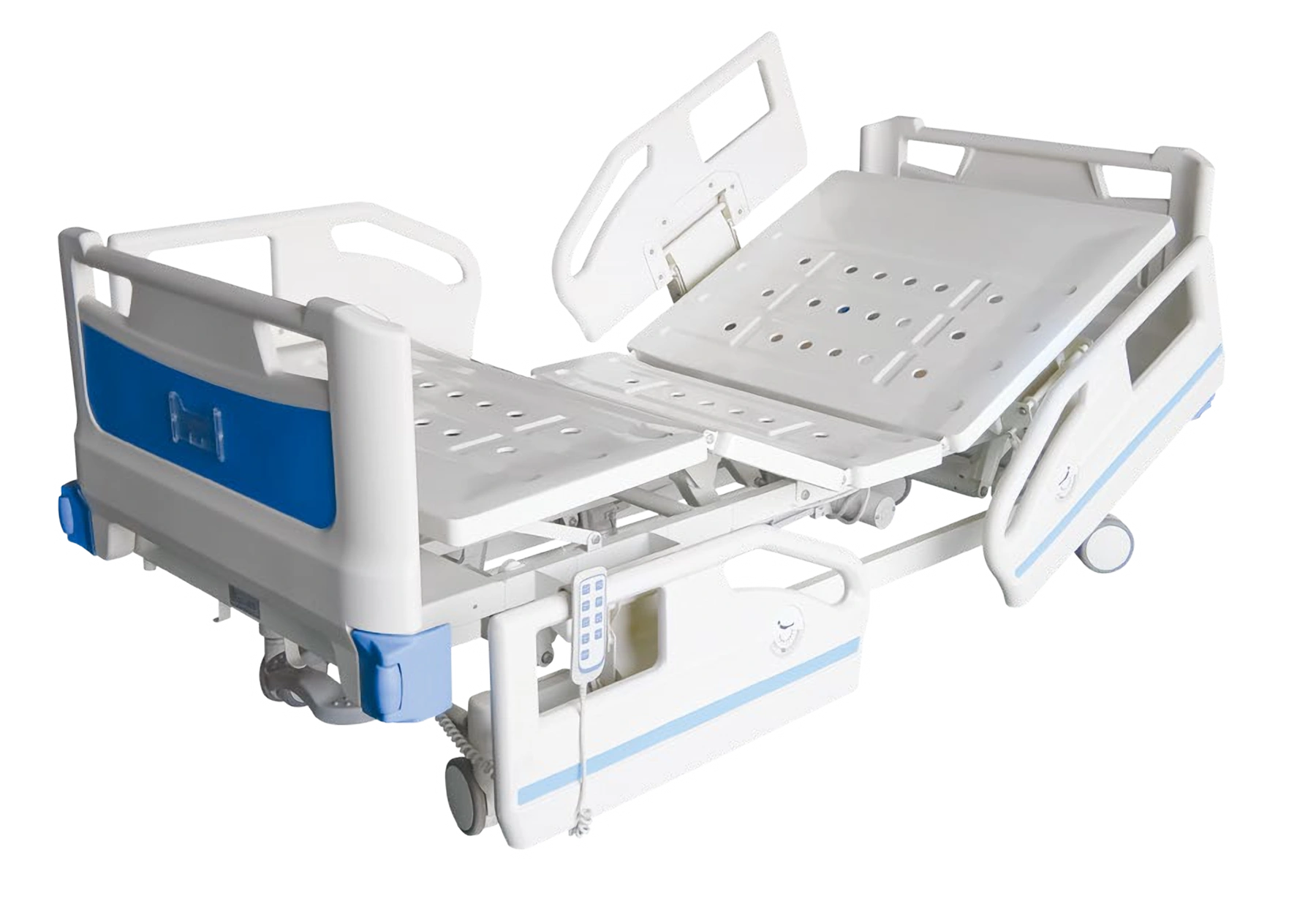
General-purpose patient beds for inpatient wards and standard hospital rooms.
View product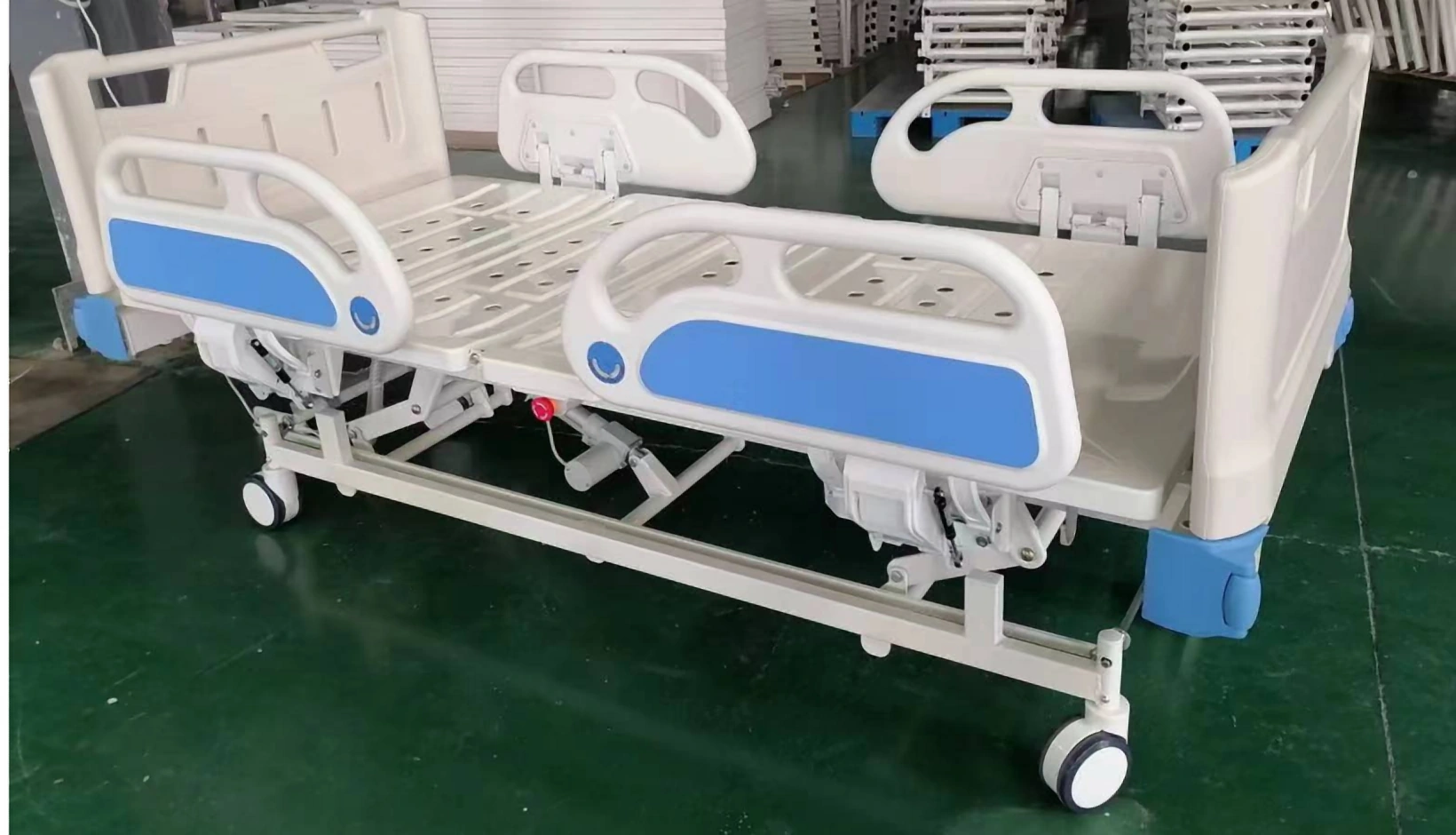
Electric Hospital Beds
Motorized multi-function beds with electric height, backrest, and leg adjustment options.
View product
Ward Furniture
Complete ward furniture options for patient rooms and hospital care areas.
View product