
When you're sourcing ambulance folding stretchers for a medical supply project, the first question is usually about price. You have a budget and a quantity, and you need to find a supplier who can meet it. But a more important first question is: what are the exact folded dimensions of the stretcher, and what are the internal dimensions of your ambulance's storage compartment?
This might seem like a minor detail, but it's a common point of failure for stretcher procurement projects. Ordering dozens of units only to discover they don't physically fit in your vehicle fleet is a costly, time-consuming mistake. It turns a simple procurement task into a major project delay.
The real challenge isn't finding the lowest price, but confirming the product you order is operationally compatible with your vehicles, your crew, and your patient transport requirements.
Choosing the right ambulance folding stretcher for a project involves matching the product's specifications to your operational needs. Key factors to check are the stretcher's folded dimensions for vehicle compatibility, its net weight for crew handling, its dynamic load capacity for patient safety, and confirmation of what accessories like mattresses and straps are included in the price.
This article provides general guidance for procurement planning. It is not a substitute for professional medical advice, local regulatory standards, or specific patient handling protocols. Buyers should confirm all final equipment specifications and safety requirements with their clinical teams and relevant authorities before purchase.
How Do You Check if a Stretcher Will Fit Your Ambulance Fleet?
Many buyers start by looking for a "standard" ambulance stretcher, assuming it will fit any vehicle. In reality, there is no universal standard. Ambulance models, interior layouts, and storage bracket systems vary widely. A stretcher that fits one fleet perfectly may be too long, too wide, or too high when folded to fit another.
A key specification to verify first is the folded dimensions. A supplier's specification sheet should list this as Length x Width x Height (L x W x H).
Before you even request a quotation, measure the internal space of your ambulance's storage compartment. This single piece of data will immediately help eliminate unsuitable options and save you a significant amount of time.
One practical way to reduce risk is with a physical "Ambulance Fit-Test."
- Request a pre-production sample: Don't just review it in a meeting room.
- Test it in the actual vehicle: Does it slide into the storage compartment easily? Does it secure properly in the mounting brackets? Is there any obstruction?
This simple test is an effective way to de-risk your project. If a physical test isn't possible, provide the supplier with precise measurements and photos of your storage bay. Ask them to confirm in writing that their recommended model will fit the space you have defined.
What Makes a Stretcher Easy (or Difficult) for Your Crew to Handle?
Two stretcher quotations might both list an "aluminum alloy frame," but this doesn't mean they will perform the same. If one stretcher weighs 9kg and the other weighs 12kg, they are not the same product for the crew member who has to lift it twenty times a day.
The stretcher's net weight is an important factor for crew well-being and long-term operational efficiency. A lighter stretcher can reduce physical strain on your crew over a long shift, which is an important consideration for their daily work. A lighter stretcher, often made from a higher-grade aluminum alloy, may have a higher unit cost but can be a worthwhile consideration for your team.
Beyond weight, consider these handling factors:
- Folding Mechanism: Is it simple and intuitive to operate under pressure? A mechanism with clear, positive-locking steel pins gives the crew confidence that the stretcher is secure.
- Balance: Is the stretcher well-balanced when carried?
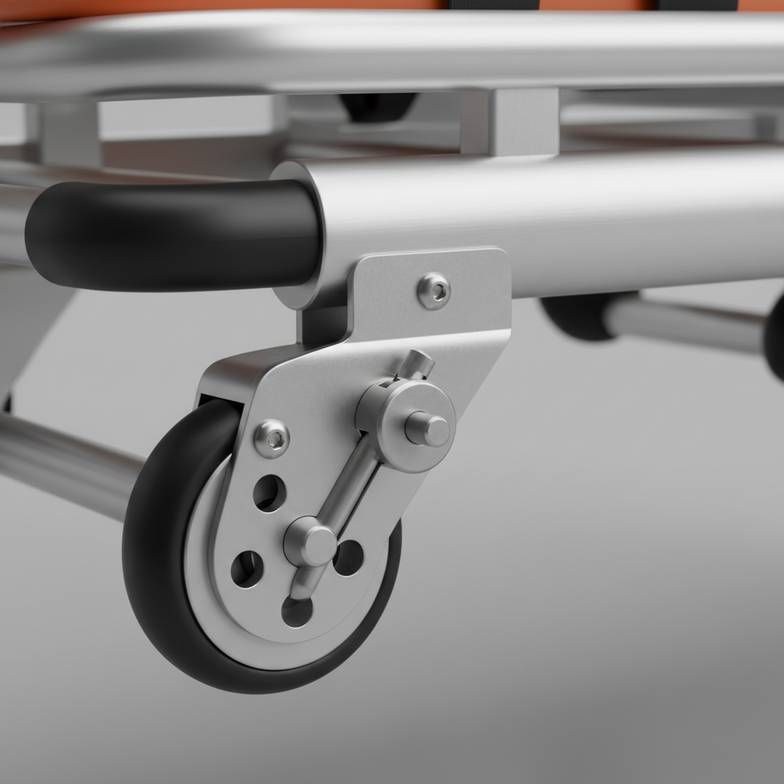
- Wheels: Are the wheels large enough to roll smoothly over uneven pavement, not just smooth hospital floors? Do they have brakes that lock securely for patient transfers?
When inquiring, don't just ask if the frame is aluminum. Ask for the specific net weight of the stretcher without accessories. This gives you a clear basis for comparing the physical demand each model will place on your staff.
Which Specifications Relate Directly to Patient Safety?
A stretcher's primary function is to transport a patient. While all stretchers have a stated load capacity, not all capacity figures are equal.
You should also check the dynamic load capacity. While static capacity measures strength when stationary, dynamic capacity relates to performance while in motion, a key consideration for real-world use. Your project may require a higher dynamic capacity to accommodate certain patient demographics.
Other key features to confirm are:
- Leg Locking System: The legs should lock firmly in place with minimal wobble. Ask for details on the locking mechanism; durable steel pins are often a sign of a more robust design.
- Patient Restraint Straps: A stretcher is not ready for use without straps. Confirm how many straps are included, their material, and the type of buckle (e.g., quick-release). A low price that excludes straps is not a true saving.
- Mattress Pad: For hygiene purposes, mattress materials should be non-porous and fluid-resistant. A material like a PVC-coated fabric makes the surface easier to clean and disinfect between patients.
A Practical Checklist for Comparing Ambulance Stretcher Quotations
Comparing quotations based on unit price alone is a common mistake. A low price often hides an incomplete or lower-specification product. Use a checklist to force an "apples-to-apples" comparison and help you evaluate complete, ready-to-use products.
A higher-priced quotation is not automatically worse. The real problem is an unclear quotation. A quote that seems high might be the only one that has correctly included the necessary mattress, straps, and robust packing. The first goal is not to find the lowest price, but to get all suppliers to quote on the same, complete basis.
Stretcher Specification Checklist for Project Procurement
| Specification Item | Why It Matters for Your Project | What to Confirm with the Supplier (Example Question) |
|---|---|---|
| Folded Dimensions (L x W x H) | Determines if the stretcher will fit in your ambulance's designated storage compartment. A misfit makes the equipment unusable. | "What are the exact folded dimensions? We need to compare them against our vehicle's storage space of [X]cm x [Y]cm x [Z]cm." |
| Net Weight | Affects crew fatigue and handling. A lighter stretcher is easier for teams to manage over many calls. | "What is the net weight of the stretcher frame itself, without the mattress or accessories?" |
| Dynamic Load Capacity | Indicates the weight limit while the stretcher is in motion. This is a key factor for real-world use. | "Can you confirm the dynamic load capacity? Our project may involve transporting bariatric patients." |
| Mattress Pad Material & Inclusions | Impacts hygiene and durability. The pad should be fluid-resistant and easy to disinfect. | "Is a mattress pad included? What is it made of, and can you provide documentation on its fluid-resistant properties if required?" |
| Included Patient Straps (Number & Type) | A key component for patient security during transport. A low price may exclude straps, leading to unexpected costs and delays. | "How many patient restraint straps are included per stretcher? Can you provide details on the buckle type?" |
| Wheel Size & Brakes | Affects maneuverability on different surfaces and stability during patient transfers. | "What is the diameter of the wheels, and do they have locking brakes? Our crews often work on uneven outdoor surfaces." |
| Packing Data (Carton Dimensions & Gross Weight) | Needed to calculate your total landed cost. Inefficient packing increases freight costs. | "Can you provide the carton dimensions, gross weight per carton, and number of units per carton?" |
What Information Should You Prepare Before Asking for a Quote?
Sending a vague inquiry like "price for ambulance stretchers?" will likely get you vague, incomparable answers. A detailed inquiry signals that you are a serious buyer and helps suppliers provide a faster, more accurate quotation that meets your project's real needs.
To get a fast and accurate quotation for your ambulance stretcher project, prepare the following information before contacting a supplier:
1. Project Quantity: The total number of stretchers you need. 2. Vehicle Storage Dimensions: The maximum length, width, and height of your ambulance's storage compartment. 3. Key Performance Needs: Your required dynamic load capacity and preferred maximum net weight. 4. Required Accessories: Confirm if you need a mattress pad (and material type) and a specific number/type of patient straps. 5. Logistics Information: Your destination port for a freight cost estimate.
Sending these details in your first email will help suppliers provide a complete and comparable quotation that truly fits your project needs.
Written by
CareFurnex Team
CareFurnex Team shares practical knowledge about hospital beds, patient room furniture, medical trolleys, clinic furniture, and healthcare facility procurement for international B2B buyers.
Related Products

Hospital Stretchers
Patient transfer stretchers for emergency rooms, wards, clinics, and healthcare projects.
View product
Hospital Beds
General-purpose patient beds for inpatient wards and standard hospital rooms.
View product
Ward Furniture
Complete ward furniture options for patient rooms and hospital care areas.
View product