
Are you sourcing hospital beds from overseas? You’ve spent weeks comparing models and negotiating prices, but a critical detail can make or break your entire project: the packing. The thought of your carefully selected beds arriving damaged after a long sea journey is enough to cause any procurement manager anxiety. This is where a clear understanding of hospital bed wooden crate packing becomes your most valuable tool, ensuring your investment arrives safe, sound, and ready for deployment.
Hospital bed wooden crate packing is a specialized export packaging method. It uses a custom-built wooden structure—like a plywood case or a slatted crate—to shield hospital beds from impact, compression, and handling damage during international shipping. It's especially vital for high-value beds or any shipment traveling via Less than Container Load (LCL).
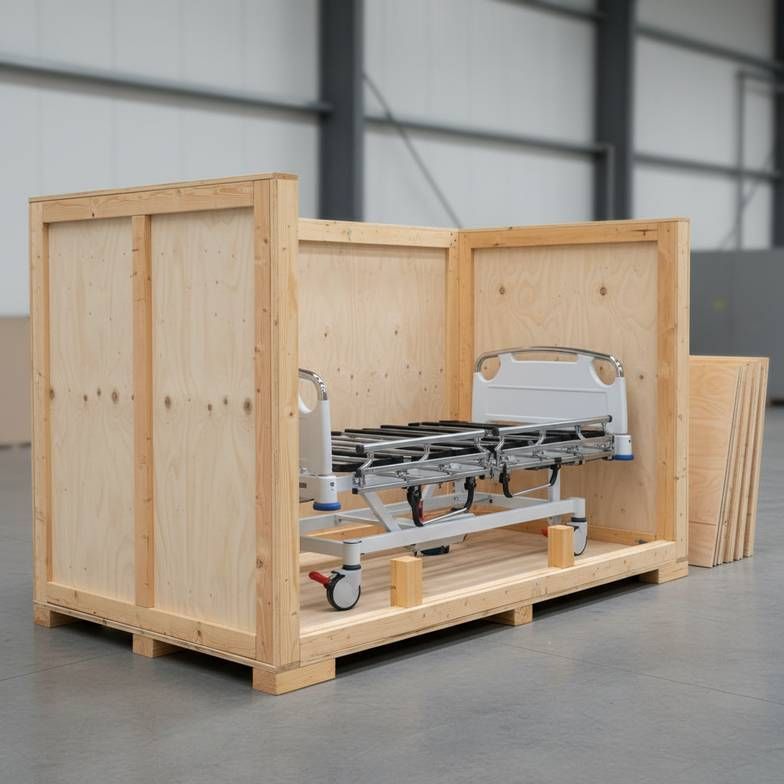
Choosing the right packing isn't just about a box; it's about managing risk. The real decision isn't whether to use a crate, but when and what kind of crate to use. Getting this right from the start can save you from the enormous costs and delays of damaged goods.
When is Hospital Bed Wooden Crate Packing Really Necessary?
You're looking at your proforma invoice and notice a line item for "Wooden Crating." It feels like an upsell. Is your supplier just trying to increase the order value, or is this charge a non-negotiable part of a successful shipment? This is a question I get all the time.
The short answer is that you don't always need a full wooden crate. For Full Container Load (FCL) shipments, where your goods are the only thing in the container, high-quality reinforced cartons are often perfectly adequate. Crates become essential for Less than Container Load (LCL) shipments.
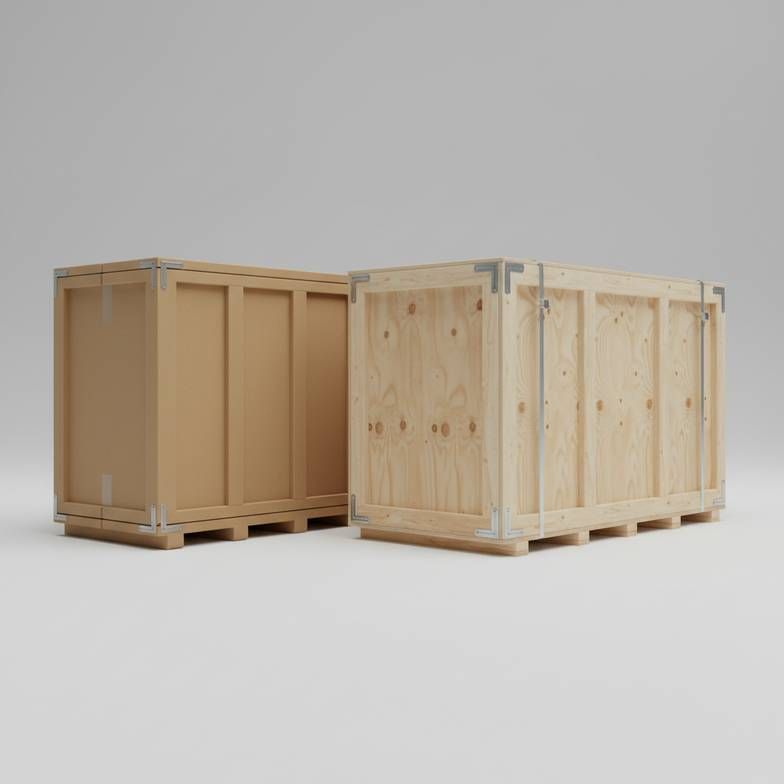
Dive Deeper: The Critical Difference Between FCL and LCL
The decision to use a crate almost always comes down to your shipping method. Think of it this way:
- Full Container Load (FCL): You are renting the entire shipping container. Your goods are loaded at the factory, the container is sealed, and it's not opened again until it reaches your warehouse. The risk of damage from other cargo is virtually zero. It's like hiring a private moving truck that goes directly from Point A to Point B. For many FCL shipments of standard manual or electric beds, a strong, multi-layer corrugated carton with internal foam supports is sufficient. We have successfully shipped many containers this way.
- Less than Container Load (LCL): You are sharing container space with goods from other shippers. This is where the danger lies. Your hospital beds will be loaded and unloaded multiple times at consolidation warehouses. They might be stacked underneath heavy, awkwardly shaped cargo. They are at high risk of being bumped by forklifts or shifting during transit. LCL shipping is like sending your furniture through a general parcel service—it's going to get handled, and not always gently. For any LCL shipment, a wooden crate is not an option; it's a necessity.
Beyond Shipping Mode: Product Value and Structure
Even with FCL shipments, there are times when extra protection is wise. Consider the value and type of bed you are shipping.
- High-Value Beds: If you are shipping sophisticated ICU beds, bariatric beds, or complex multi-motor electric beds, the cost of potential damage is extremely high. A single damaged ICU bed could represent a loss of thousands of dollars and halt the commissioning of a critical hospital room. In these cases, the small additional cost of a crate or a reinforced pallet base is cheap insurance.
- Disassembly and Delicate Parts: Some beds are shipped partially disassembled to save on volume. The headboards, footboards, side rails, and control panels are packed separately. A crate provides a rigid structure that keeps all these components together and protects them from being lost or crushed.
Here’s a simple table to guide your decision:
| Shipping Scenario | Recommended Packing | Rationale |
|---|---|---|
| FCL, Manual Beds | Reinforced Cartons | Low handling risk, most cost-effective. |
| FCL, Electric/ICU Beds | Reinforced Cartons or Pallet Base | Adds protection from forklifts at a minimal cost. |
| LCL, Any Bed Type | Wooden Crate/Case (Mandatory) | High risk of compression and impact damage. |
| Air Freight | Wooden Crate/Case | Frequent handling and high risk of impact. |
What Are the Different Types of Hospital Bed Wooden Crate Packing?
Your supplier agrees that a "wooden box" is needed for your LCL shipment. Problem solved, right? Not so fast. The term "wooden crate" can mean several different things. If you don't clarify what you're getting, you could end up with packing that isn't suitable for your product.
"Wooden crate" isn't a single solution. The main options are a fully-enclosed plywood case for maximum protection, a slatted wooden crate for basic structural integrity, or a reinforced wooden pallet base to prevent damage from below. Each serves a different purpose.
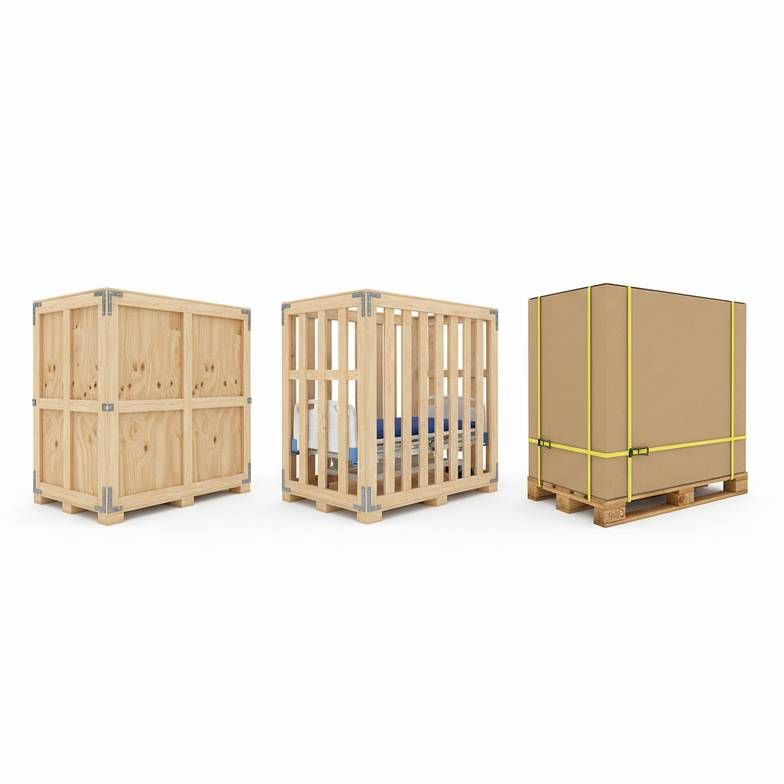
Dive Deeper: Deconstructing the "Wooden Box"
As a buyer, you need to know what to ask for. Don't just accept a vague line item on a quote. Ask your supplier for photos and specifications of the proposed packing. Here are the main types you'll encounter:
The Fully-Enclosed Plywood Case
This is the gold standard for protection. It’s a solid box, typically constructed with a solid wood frame and covered with sheets of plywood.
- Best for: High-value electric and ICU beds, all LCL shipments, and air freight.
- Pros: It offers the best possible protection against everything—impacts from other cargo, compression from stacking, dust, moisture, and even theft.
- Cons: It's the heaviest, bulkiest, and most expensive option. It will add to your total shipping weight and volume (CBM), which increases freight costs.
- My Advice: When a client is shipping a single, expensive ICU bed via LCL, I tell them this is the only option I'm comfortable with. The risk of using anything less is just too great.
The Slatted Wooden Crate
This is a more economical option. It consists of a solid wood frame, but instead of being fully enclosed with plywood, it has wooden slats with gaps in between.
- Best for: Sturdier manual beds in an LCL shipment where budget is a major factor.
- Pros: It's lighter and cheaper than a full case while still providing excellent structural protection against being crushed or suffering a major impact.
- Cons: It offers little protection from dust, moisture, or sharp objects that can get through the gaps. It also makes the contents visible, which can sometimes be a downside.
The Reinforced Pallet Base
This is the most basic form of wooden packing. The hospital bed, often still in its original cardboard carton, is simply strapped securely onto a custom-built wooden pallet.
- Best for: Adding a layer of security to FCL shipments without the full cost of a crate.
- Pros: It's very cost-effective. Its main job is to keep the bed off a potentially wet warehouse floor and provide a stable base for a forklift, preventing damage to the bed's undercarriage.
- Cons: It provides zero protection to the top or sides of the bed.
- My Advice: For FCL shipments of electric beds, I often suggest adding a pallet base. It's a small price to pay to prevent the most common type of loading/unloading damage.
What are the Compliance Rules for Hospital Bed Wooden Crate Packing?
You did everything right. You identified your shipment as LCL, insisted on a fully-enclosed plywood case, and approved the cost. Your beds are now on the ocean, and you feel secure. Then you get an urgent call from your customs broker. The shipment is being held at the port. Why? Because the wood wasn't properly treated.
This is a nightmare scenario, and it's entirely avoidable. Any solid wood packaging used for international trade must be treated and marked according to the ISPM 15 standard. This is not optional; it's a legal requirement in over 180 countries.
A supplier's failure to comply with ISPM 15 can result in your entire shipment being delayed, refused entry, or even destroyed by customs authorities—all at your expense.
Dive Deeper: The Non-Negotiable ISPM 15 Standard
ISPM 15 is one of the most important but overlooked aspects of exporting. Here's what you need to know:
What is ISPM 15?
ISPM 15 (International Standards for Phytosanitary Measures No. 15) is a global standard developed to prevent the international transport and spread of diseases and insects that could negatively affect plants and ecosystems. It applies to all solid wood packaging material (WPM), including pallets, crates, and dunnage.
- What needs treatment: The solid wood used to build the frame of a crate or pallet must be treated. Processed wood products like plywood, particle board, and OSB are exempt, but the lumber used to hold them together is not.
- How it's done: The wood must be debarked and then treated, either via heat treatment (HT) to a core temperature of 56°C for at least 30 minutes, or fumigated with Methyl Bromide (MB). Heat treatment is now the most common and environmentally preferred method.
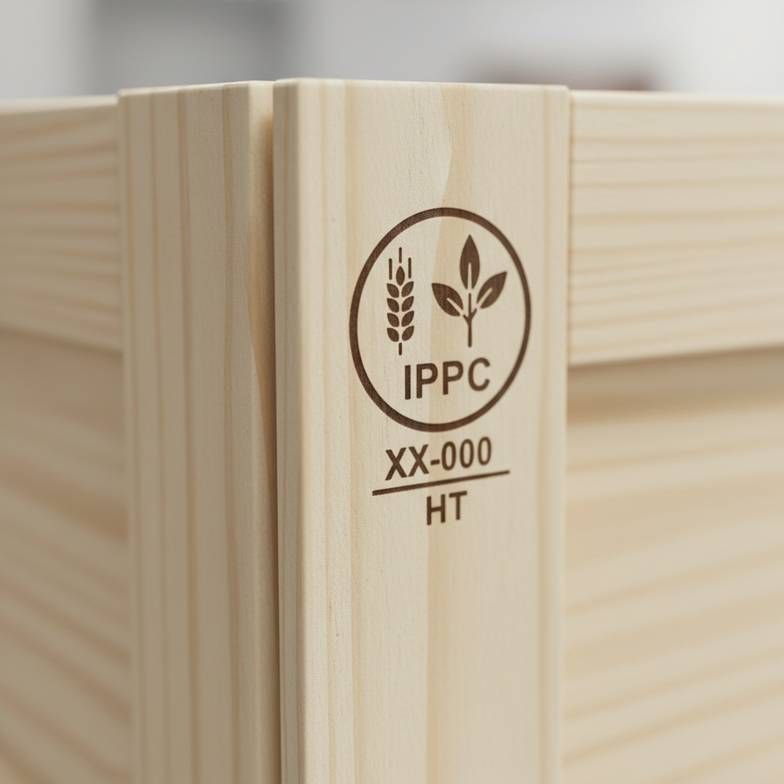
The IPPC "Wheat Stamp"
How do customs officials know the wood is compliant? They look for the stamp. Every piece of treated wood packaging must be marked with the official IPPC (International Plant Protection Convention) symbol.
This mark, often called the "wheat stamp," must include:
- The IPPC wheat symbol.
- The two-letter ISO country code (e.g., CN for China).
- A unique code for the company that performed the treatment.
- The treatment code: HT for heat treatment or MB for fumigation.
I once worked with a new client who had a shipment from a different supplier held up at the Port of Los Angeles for weeks. The factory had used untreated wood for the pallets. The client had to pay for emergency fumigation at the destination port, a process that cost thousands of dollars and completely erased his profit margin.
Your Role as the Buyer
You can't afford to be passive about this. It's your responsibility to ensure compliance.
- Verify: During the quotation stage, explicitly ask your supplier: "Is your wooden packing material ISPM 15 compliant and properly stamped?"
- Document: For many countries, you may need a statement on the commercial invoice or a separate fumigation/heat treatment certificate. Know your country's requirements.
- Confirm: Ask for photos of the stamp on the finished crates before they are loaded. A reliable partner will provide this as part of their standard pre-shipment quality control process. At CareFurnex, this is a mandatory step in our export checklist.
Frequently Asked Questions
How much does wooden crate packing add to the cost?
It can vary significantly based on the size of the bed and the complexity of the crate, but you can typically expect it to add between 3% and 10% to the product's FOB price. Always weigh this against the potential cost of a damaged bed, which represents a 100% loss plus project delays and reputational damage.
Does hospital bed wooden crate packing increase shipping costs?
Yes, it does. A crate adds both weight and volume (measured in cubic meters, or CBM) to your shipment, which are the two factors that determine freight costs. However, for an LCL shipment, the small increase in freight cost is negligible compared to the financial protection it provides.
Can I reuse the wooden crates?
While technically possible, it's often not practical. The crates are built for secure one-way transit and are usually nailed or screwed shut tightly. Disassembling them without damage can be difficult. Furthermore, they are bulky and expensive to store. Most buyers break them down and dispose of them according to local wood recycling regulations.
Is plywood exempt from ISPM 15 rules?
Yes, the plywood sheets themselves are considered a processed wood product and are exempt from ISPM 15. However, this is a common point of confusion. The solid wood lumber used to build the crate's frame or pallet base is not exempt. That structural wood must be treated and carry the ISPM 15 stamp for the entire crate to be compliant.
Conclusion
Choosing the right export packing for your hospital beds is a critical procurement decision. It’s not an area to cut corners to save a few dollars. Think of hospital bed wooden crate packing not as an expense, but as a crucial insurance policy for your investment. By understanding the difference between FCL and LCL, clarifying the type of packing being used, and demanding proof of ISPM 15 compliance, you transform yourself from a simple buyer into a savvy project manager. Making the right choices here ensures your products arrive safely, your project stays on schedule, and you avoid catastrophic, and entirely preventable, financial losses.
At CareFurnex, we manage these logistical details for our clients every day. If you are planning a healthcare furniture project and want a partner who focuses on a secure and predictable delivery, let’s talk about your requirements.
Written by
CareFurnex Team
CareFurnex Team shares practical knowledge about hospital beds, patient room furniture, medical trolleys, clinic furniture, and healthcare facility procurement for international B2B buyers.
Related Products
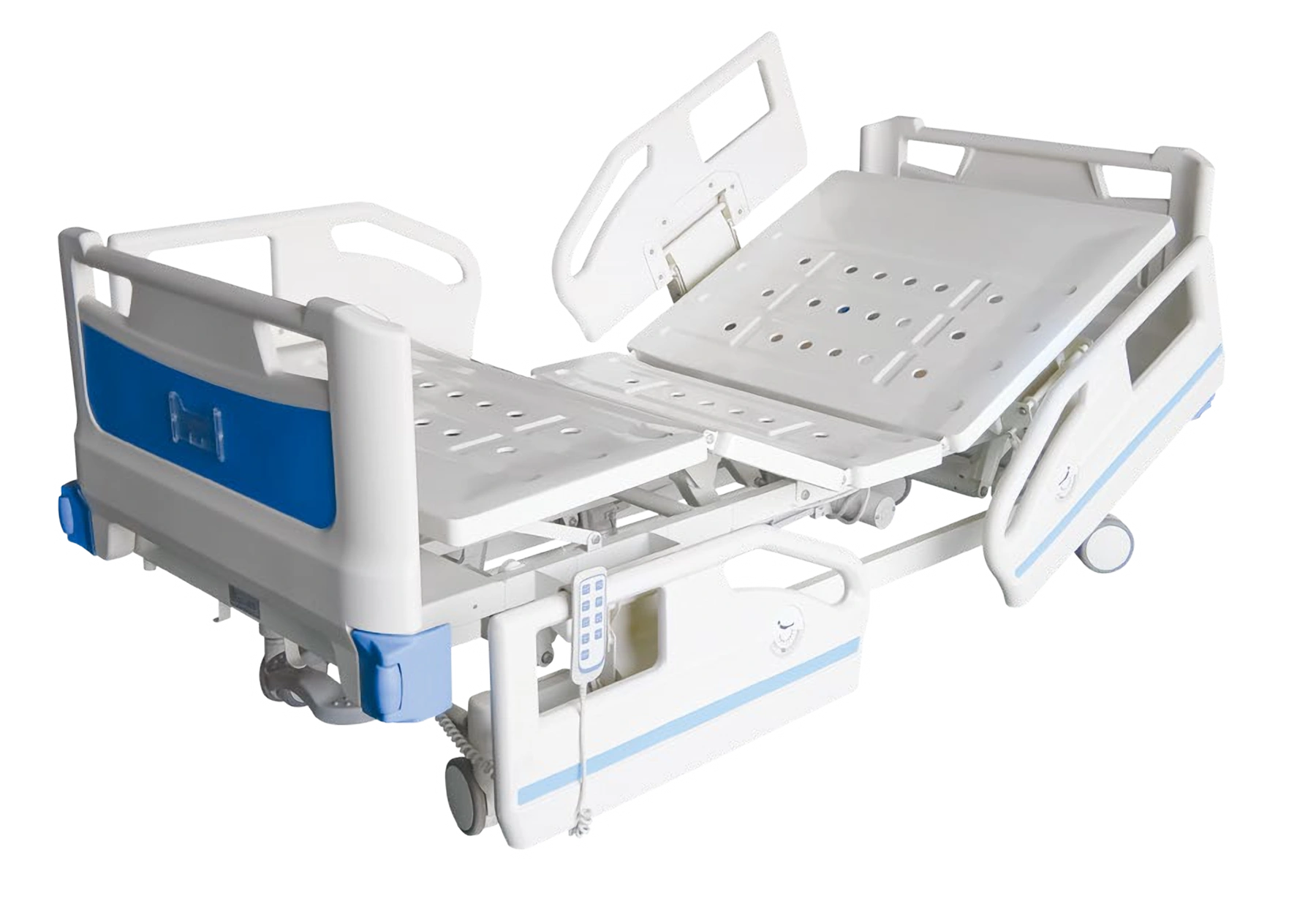
Hospital Beds
General-purpose patient beds for inpatient wards and standard hospital rooms.
View product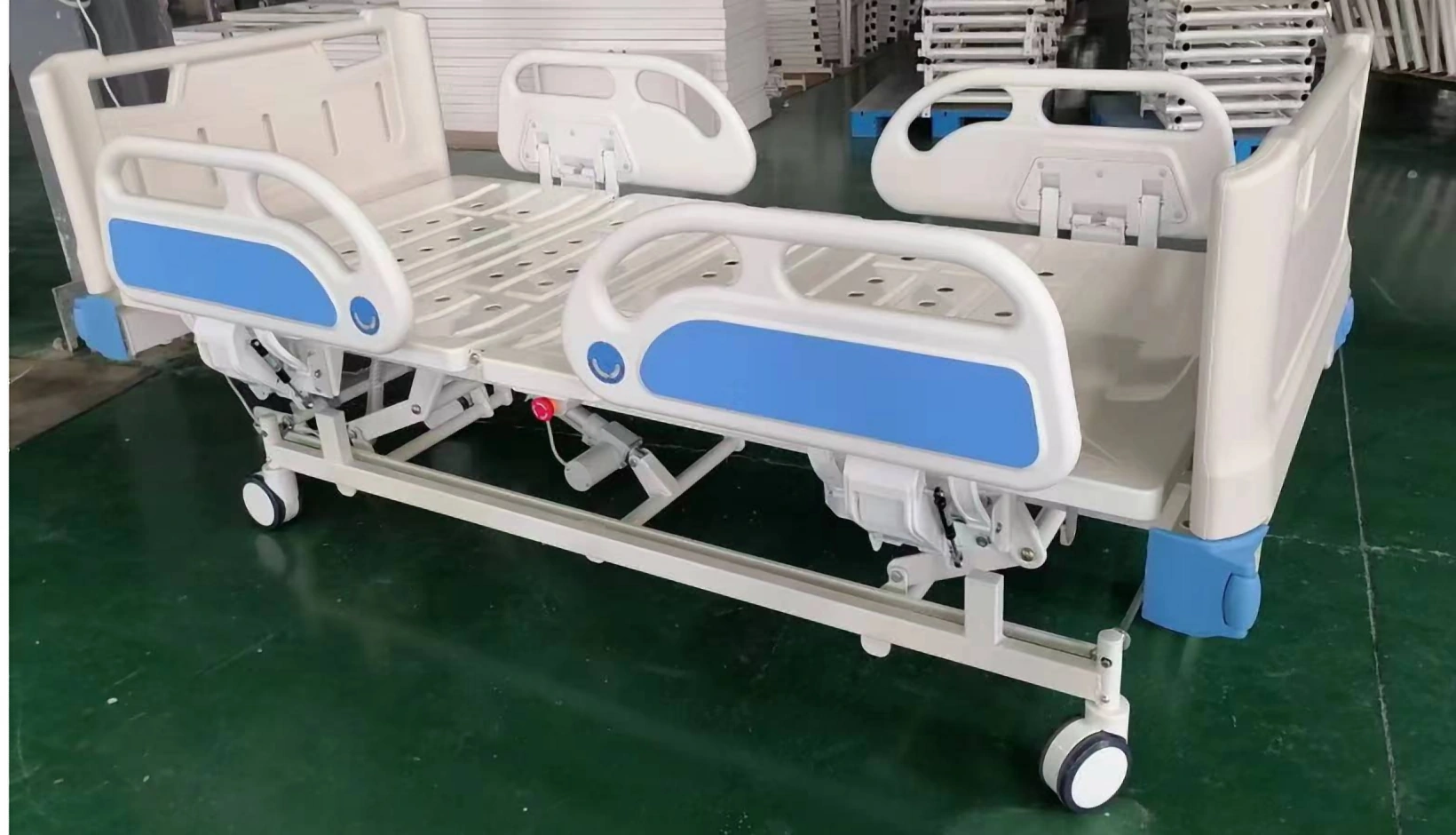
Electric Hospital Beds
Motorized multi-function beds with electric height, backrest, and leg adjustment options.
View product
Ward Furniture
Complete ward furniture options for patient rooms and hospital care areas.
View product