
The most frequent complaints about a new fleet of hospital beds often have nothing to do with the electric functions or the mattress. Instead, they are about how hard the bed is to push, or how it won't stay perfectly still during a patient transfer.
The cause is almost always a mismatch between the caster and brake system and the hospital's real-world needs. Buyers often compare bed quotations based on the main features and price, assuming the small wheels underneath are all the same. This assumption can lead to daily frustration for nursing staff and a poor return on a significant equipment investment.
When checking hospital bed casters and brakes, buyers should confirm the braking system type (central vs. individual), the caster diameter (e.g., 125mm vs. 150mm) for maneuverability, and the lock mechanism (e.g., 'total lock' vs. simple wheel lock). These choices directly affect staff workflow, ease of movement, and how securely the bed can be positioned for patient care.
From a supplier's perspective, a hospital bed is a system of components. The casters and brakes are not just accessories; they are a performance subsystem. We would rather clarify these details before production than have a buyer discover a performance mismatch after delivery. Getting this specification right helps the bed function well in its intended environment.
Why can a "standard" caster system cause daily problems?
When a quotation lists a "standard" caster, it often refers to the most common, cost-effective option, which is typically a 125mm caster with an individual brake on each wheel. While this is adequate for some situations, it may not be suitable for all hospital departments.
A buyer might see this on a specification sheet and assume it's sufficient. But if the beds are destined for a high-turnover surgical ward or a busy Emergency Room, this "standard" setup can create operational friction. Staff may find the beds hard to steer in long corridors or difficult to push over small thresholds. The time spent walking around the bed to lock four separate brakes adds up over a shift. These are the small, daily frustrations that lead to staff dissatisfaction with new equipment.
Before accepting the default option, I would ask where and how the beds will be used most. This helps determine if the "standard" configuration is a good fit or if a small upgrade would provide a much better user experience.
Central vs. Individual Brakes: What's the real-world difference?
The choice between a central braking system and individual locking casters is a classic trade-off between upfront cost and long-term workflow efficiency.
- Individual Locking Casters: Each of the four casters has its own small lever that must be pressed down to lock the wheel. This is a simple mechanism that is fine for beds that are moved infrequently, such as in a long-term care setting.
- Central Locking System: A single pedal, or a set of linked pedals at the head or side of the bed, engages the brakes on all four wheels simultaneously. This system is faster and more convenient.
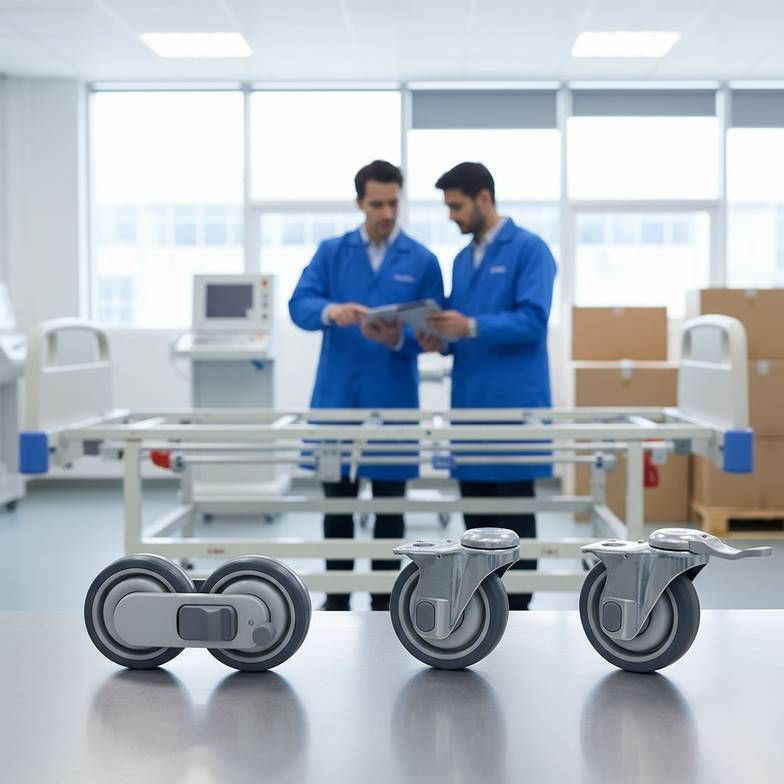
For a fast-paced environment like an ICU or ER, where staff need to secure a bed quickly and confidently, a central locking system is a significant workflow improvement. The time saved from not having to walk around the bed to engage four separate locks is valuable. While it adds a small amount to the unit cost, the efficiency gain for staff is often a worthwhile consideration.
How does caster diameter affect pushing effort?
The diameter of the caster wheel has a direct and noticeable impact on how easy the bed is to push and maneuver. The two most common sizes are 125mm (approx. 5 inches) and 150mm (approx. 6 inches).
A larger diameter wheel rolls more easily over imperfections in the floor, such as grout lines, elevator gaps, and door thresholds. This simple physics means a bed with 150mm casters requires less physical effort from staff to move, especially over longer distances or with heavier patients.
If your facility has long corridors, ramps, or numerous thresholds between rooms and departments, I would strongly recommend considering the 150mm caster option. This can noticeably reduce the physical effort for nursing and transport staff, which helps lessen the daily physical burden. The small difference in diameter on a specification sheet translates to a large difference in daily usability.
What should you confirm about a brake's locking mechanism?
A common point of confusion is what "locked" actually means. Not all brake locks are the same. The difference between a simple "wheel lock" and a "total lock" is important for stability during patient care.
- Wheel Lock: This is the most basic type of brake. It prevents the wheel from rolling forward or backward. However, the caster housing can still swivel or pivot.
- Total Lock: This is a more secure mechanism. When engaged, it locks both the wheel's rotation and the caster's swivel.
The difference becomes apparent during a patient transfer or a bedside procedure. A bed with only wheel locks can still "shimmy" or pivot slightly, which can be unsettling for the patient and inconvenient for the caregiver. A bed with a total lock provides a more stable and rigid platform.
When you receive a quotation, if it just says "locking casters," it is worth asking the supplier to clarify: "Is this a total lock that secures both roll and swivel?" For any application where stability is a priority, confirming a total lock is a practical step.

Checklist: Key Caster and Brake Questions for Your Supplier
Use this checklist to prepare your inquiry and compare quotations more effectively. A clear specification helps you receive comparable offers and helps reduce surprises with the final product.
| Specification Choice | Key Options | What to Ask Your Supplier |
|---|---|---|
| Braking System | Individual Locking vs. Central Locking | "Is a central locking system included, or is it a priced upgrade? What is the cost difference?" |
| Caster Diameter | 125mm (Standard) vs. 150mm (Upgrade) | "For our floor conditions with several thresholds, would you recommend 150mm casters to reduce pushing effort?" |
| Lock Mechanism | Wheel Lock vs. Total Lock | "Can you confirm if the brake is a 'total lock' that secures both the wheel and the swivel for better stability?" |
| Caster Material | TPR (Thermoplastic Rubber) vs. PU (Polyurethane) | "Are these caster materials non-marking and resistant to our hospital's standard chemical cleaning agents?" |
| Load Capacity | Standard Dynamic Load | "What is the dynamic load capacity per caster, and is it suitable for the bed's full Safe Working Load (SWL)?" |
Preparing Your Hospital Bed Inquiry
Before you request a final quotation for hospital beds, preparing a clear list of your operational needs will help a supplier provide a more accurate and useful recommendation. For each group of beds in your project, try to have the following information ready:
- The intended department (e.g., ICU, General Ward, ER, Bariatric Unit).
- The primary use (e.g., frequent transport between departments vs. mainly in-room recovery).
- Any challenging floor conditions (e.g., long corridors, ramps, frequent door thresholds).
With this information, you can ask your supplier to confirm the braking system type, caster diameter, and lock mechanism that are included in their quotation. This preparation makes your comparison clearer and helps reduce surprises after the order is placed.
Written by
CareFurnex Team
CareFurnex Team shares practical knowledge about hospital beds, patient room furniture, medical trolleys, clinic furniture, and healthcare facility procurement for international B2B buyers.
Related Products
Hospital Beds
General-purpose patient beds for inpatient wards and standard hospital rooms.
View product
Electric Hospital Beds
Motorized multi-function beds with electric height, backrest, and leg adjustment options.
View product
Ward Furniture
Complete ward furniture options for patient rooms and hospital care areas.
View product