
If you have ever requested prices for a "Fowler bed" and received three quotations that are impossible to compare, the problem isn't the suppliers. The problem is that "Fowler bed" is an incomplete question. You might see one quote that is significantly cheaper than the others, but the reason is often hidden in the specifications.
The confusion comes from treating these terms as simple product names. They are not. They describe a specific level of mechanical function. Understanding this distinction is the first step to sourcing the right bed for your department and budget.
The main difference is the number of adjustable sections: a Semi-Fowler bed is a 1-function bed with only backrest adjustment, while a Fowler bed is a 2-function bed with both backrest and knee-rest adjustment. Your choice depends on the intended departmental use, patient mobility needs, and how the knee-lift function can affect staff workload.
From a supplier's perspective, a request for a "Fowler bed" without more detail is a guess. Before we can provide a useful quotation, we need to know if you require a 1-function or 2-function bed, if it should be manual or electric, and what other components like side rails and casters are needed. Clarifying this upfront prevents mismatched quotes and sourcing errors.
What Is the Functional Difference Between a 1-Function and 2-Function Bed?
A practical way to think about this is in terms of mechanical functions, which correspond to the number of cranks on a manual bed or motors on an electric bed.
- Semi-Fowler (1-Function): This bed offers only backrest adjustment. A manual version will have one crank, and an electric version will have one motor for this function. It allows a patient to be raised from a lying-down position to a seated or semi-seated position, which is useful for feeding, reading, or basic comfort.
- Fowler (2-Function): This bed offers both backrest and knee-rest adjustment. A manual version has two separate cranks, and an electric version has two motors. The ability to raise the knee section is the key difference.
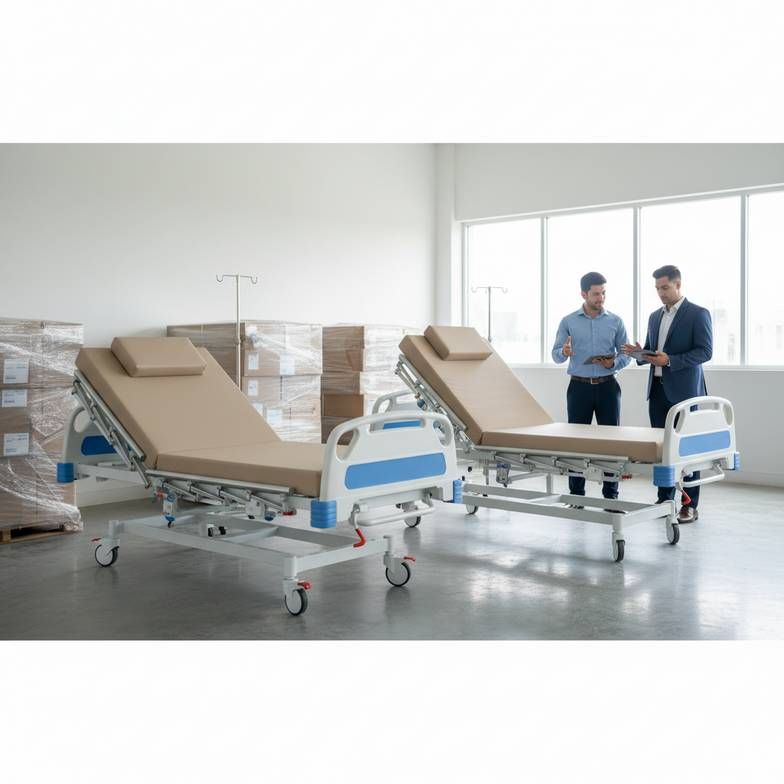
When you request a quotation, specifying "1-function" or "2-function" is much clearer than using the names alone. This simple change helps you compare offers on a like-for-like basis.
When Is the Knee-Lift Function a Practical Necessity?
Many buyers view the knee-lift function as a minor comfort feature and opt for the cheaper 1-function Semi-Fowler bed to save on the initial budget. This can be a mistake depending on the use case. The knee-lift is a clinical and workflow tool.
When a patient's back is raised, gravity can cause them to slide down toward the foot of the bed. The knee-lift on a 2-function Fowler bed creates a contour that acts as a physical stop, holding the patient more securely in place.
This has two important outcomes: 1. Improved Patient Positioning: It helps prevent the patient from sliding toward the foot of the bed. This maintains a more stable and comfortable seated position, reducing the need for constant adjustments. 2. Reduced Staff Workload: Nurses do not have to constantly reposition patients who have slid down. This saves physical effort and time over the course of a day, especially in wards with high-dependency patients.
For a general ward where patients are mobile and only sit up for meals, a 1-function Semi-Fowler bed may be sufficient. But for a post-operative recovery unit, a long-term care facility, or any department where patients are seated for extended periods, the 2-function Fowler bed often provides better value by improving staff efficiency and patient stability.
How Does Choosing Between Manual and Electric Affect Your Decision?
Both 1-function and 2-function beds are available in manual (crank-operated) and electric (motor-operated) versions. The choice is not just about price; it's about who will be making the adjustments and how often.
- Manual Beds: These use hand cranks, typically located at the foot of the bed, for adjustments. They are a lower-cost and reliable option that does not depend on electricity. However, adjustments require staff effort and can be slower.
- Electric Beds: These use a handset with buttons to control electric motors. They allow patients or staff to make adjustments quickly and with minimal physical effort. This can promote patient autonomy and reduce strain on nursing staff.
A common mistake is assuming an electric bed is automatically a multi-function bed. You can purchase a 1-motor electric bed that only adjusts the backrest (an electric Semi-Fowler). When preparing your inquiry, be specific: "electric 2-function bed" or "manual 1-function bed."
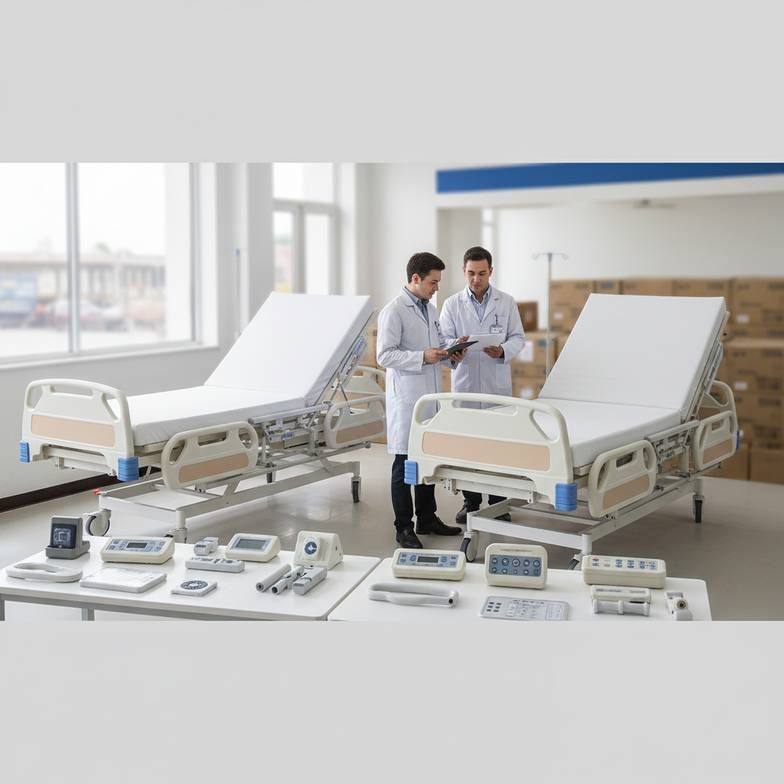
What Other Specifications Should You Confirm?
The bed frame is a platform. Its daily utility and safety are affected by other components that are often overlooked in initial inquiries. A low price on a bed might be due to lower-spec components.
I would suggest checking the specifications for all major components. A low price on the bed frame might be due to lower-spec components elsewhere. These details have a direct impact on usability and daily operations.
Comparison Checklist: From Function to Full Specification
| Feature Area | Key Decision Point | What to Specify in Your Inquiry |
|---|---|---|
| 1. Core Function | Do you need backrest only, or backrest + knee-lift? | "1-Function (Semi-Fowler)" or "2-Function (Fowler)" |
| 2. Drive Mechanism | Will adjustments be by staff (manual) or patient/staff (electric)? | "Manual (crank-operated)" or "Electric (motor-operated)" |
| 3. Side Rails | What matches your workflow and safety protocols? | "Collapsible aluminum alloy side rails" or "Split ABS plastic side rails" |
| 4. Casters & Brakes | What level of mobility and stability is needed? | "125mm casters with individual brakes" or "Central locking brake system" |
| 5. Head & Foot Boards | Do they need to be removable for procedures? | "Detachable ABS head and foot boards" |
| 6. Included Accessories | What needs to be part of the package? | "Price should include IV pole and mattress" (or "Quote accessories separately") |
| 7. Packing | How will the beds arrive and what is the shipping volume? | "Confirm packing method (e.g., SKD) and provide carton dimensions/CBM" |
Asking for these details turns a vague request into a specific one, helping suppliers to quote on the same basis and making your decision process much clearer.
How to Prepare an Inquiry for Clear, Comparable Quotations
Vague inquiries like "price for hospital beds" lead to vague quotations and wasted time. A well-prepared request allows a supplier to respond with an accurate and relevant offer that you can confidently compare against others.
The goal is to move from asking about a product name to defining a product specification. Instead of just asking for a Fowler bed, you are now ready to ask for a bed that meets your exact functional, operational, and budgetary needs.
Before contacting a supplier, prepare a list with the following details for each type of bed you need:
- Required Functions: "1-Function" or "2-Function."
- Drive Mechanism: "Manual" or "Electric."
- Quantity: The number of units required.
- Key Components: Your preference for side rails (e.g., collapsible aluminum), casters (e.g., 125mm with central lock), and head/foot boards (e.g., detachable ABS).
- Accessories: Specify if an IV pole, mattress, or other items should be included in the quotation.
- Packing & Shipping: Request confirmation of the packing method (e.g., Semi-Knocked-Down) and ask for the carton dimensions and gross weight to estimate total shipping volume (CBM).
Sending this complete list allows a supplier to provide a detailed quotation that directly matches your project requirements. It makes the procurement process more efficient and reduces the risk of ordering the wrong equipment.
Written by
CareFurnex Team
CareFurnex Team shares practical knowledge about hospital beds, patient room furniture, medical trolleys, clinic furniture, and healthcare facility procurement for international B2B buyers.
Related Products
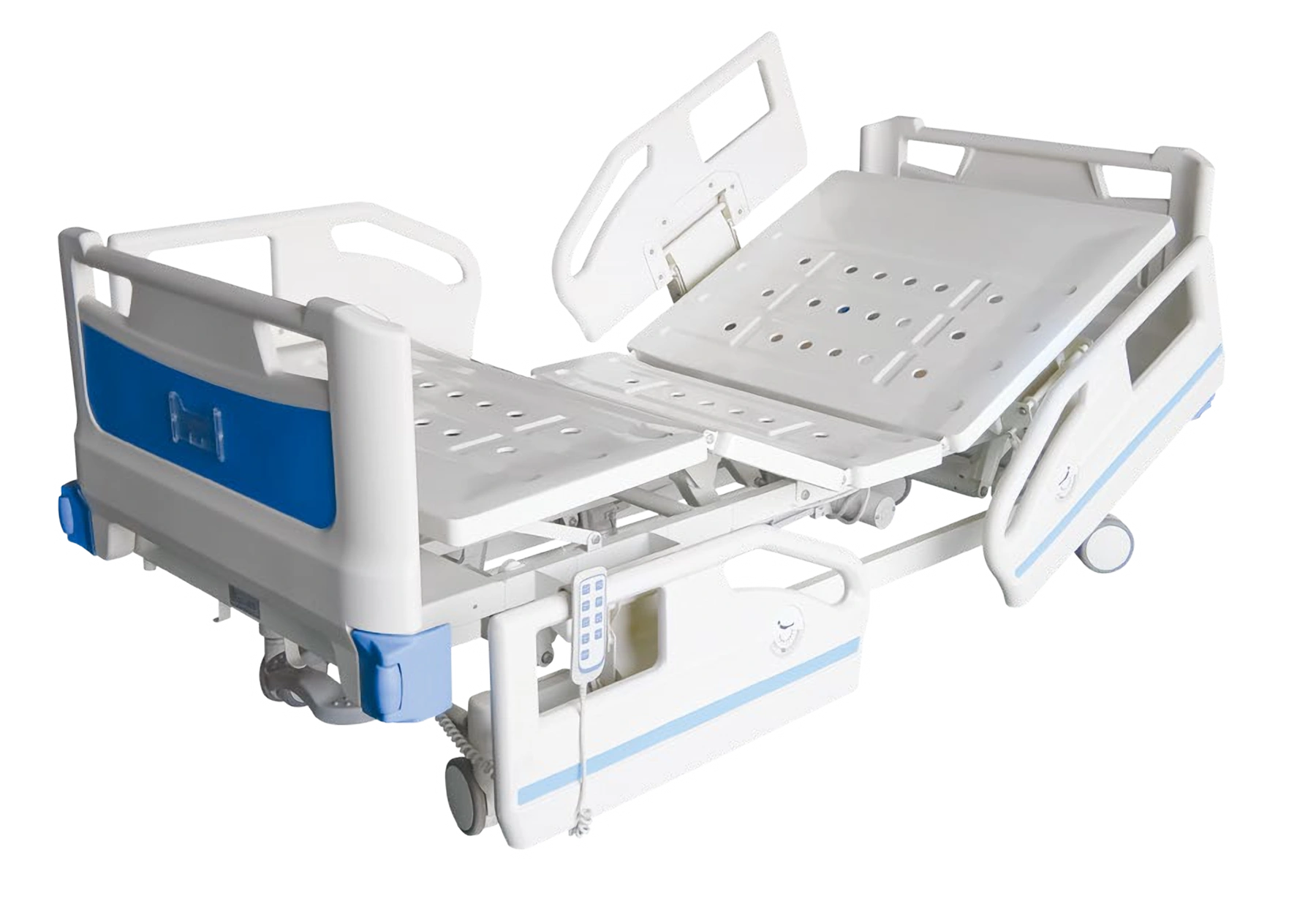
Hospital Beds
General-purpose patient beds for inpatient wards and standard hospital rooms.
View product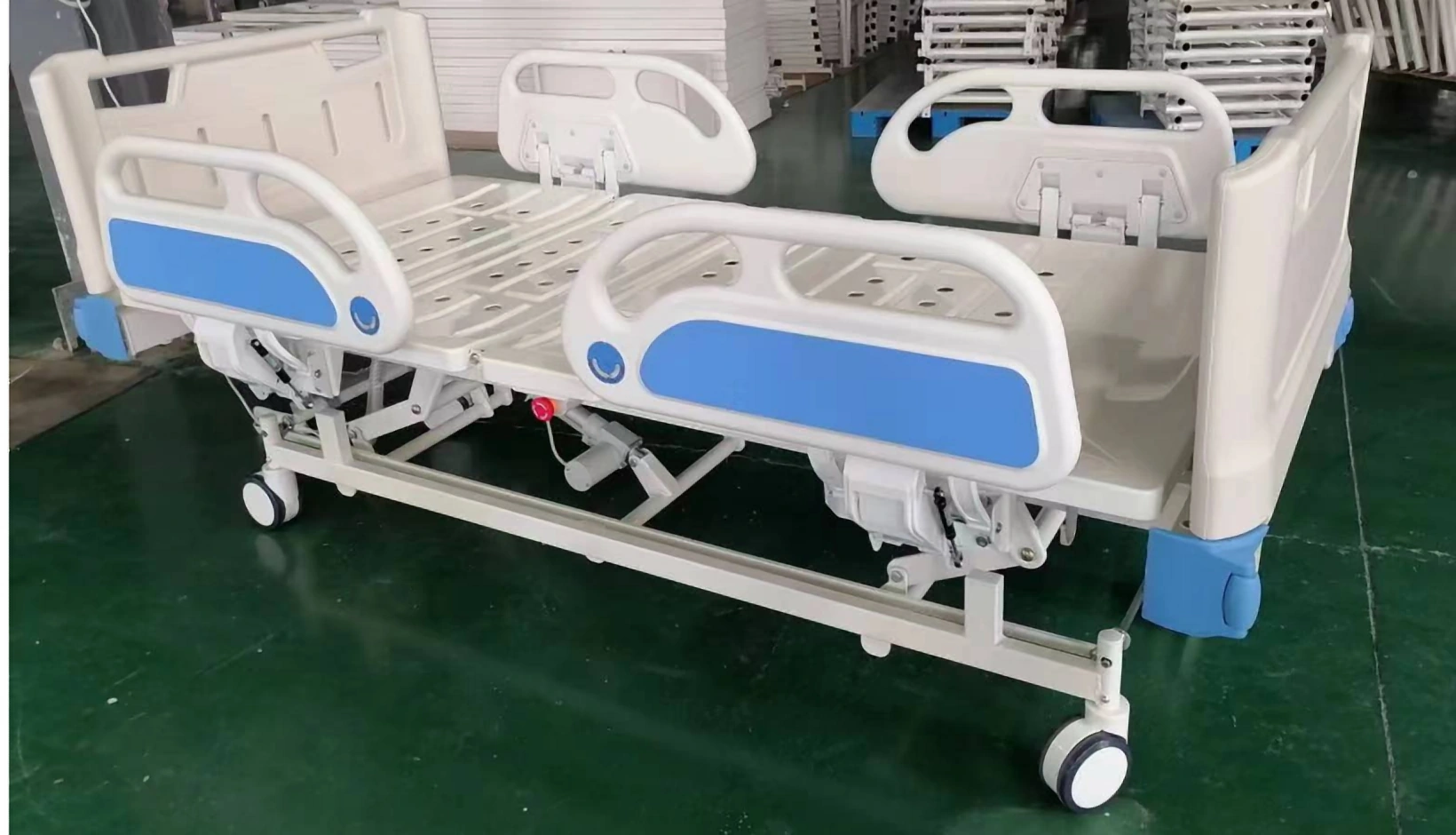
Electric Hospital Beds
Motorized multi-function beds with electric height, backrest, and leg adjustment options.
View product
Ward Furniture
Complete ward furniture options for patient rooms and hospital care areas.
View product