
A procurement list for a new ward might specify "100 hospital beds, standard size," but experienced suppliers know this is where a costly mistake can begin. You've measured the rooms and know the general bed size you need, so finalizing the order should be straightforward.
The problem is that the term "standard size" hides several important details. A small difference of 10-20cm between a bed's "mattress size" and its "overall footprint" seems minor, but it becomes a major planning failure when multiplied across dozens of rooms. This small oversight can lead to beds that don't fit, mattresses that create safety hazards, and a ward that is too cramped for your staff to work effectively.
The better question isn't "What is the price for a standard size bed?" but rather, "What are the three key dimensions I need to verify to make sure these beds work as a complete system within my facility?"
To choose the right hospital bed size, buyers should confirm three key factors: the mattress platform dimensions to prevent unsafe gaps, the bed's total overall footprint (length and width) to fit the room, and the required operational clearance for staff access and equipment movement.
This guide outlines practical planning principles for procurement. It is not a substitute for architectural, clinical, or local regulatory requirements. Buyers should always confirm final layouts, clearance specifications, and safety standards with their project consultant, clinical team, and relevant local authorities before placing an order.
What’s the Difference Between Mattress Size, Bed Footprint, and Functional Space?
When you receive a quotation for a hospital bed, the listed "size" (e.g., 200cm x 90cm) almost always refers to the mattress platform. This is the flat surface the mattress rests on. Buyers often mistake this for the total space the bed will occupy, which is incorrect.
A successful procurement plan depends on verifying three distinct dimensional layers:
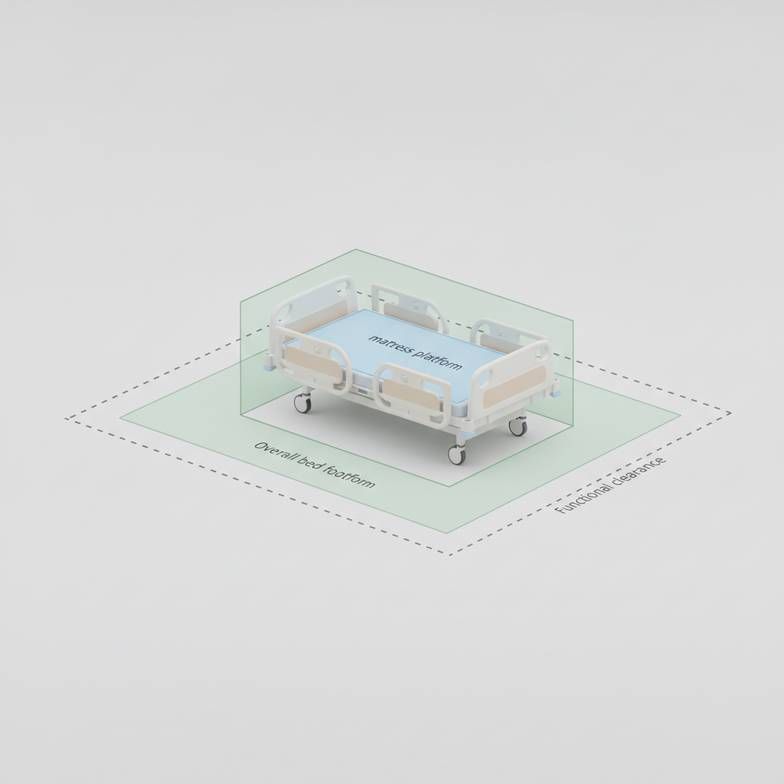
1. The Mattress Platform Dimension: This is the size of the mattress support surface. It's the most common number you'll see on a spec sheet. Its primary purpose is to help achieve a secure fit with your mattress.
2. The Overall Bed Dimension: This is the bed's maximum physical footprint from its furthest points, including the headboard, footboard, and any frame-mounted bumpers. This dimension can easily be 15-25cm longer and 10-15cm wider than the mattress platform. This is the number you must use for basic floor planning.
3. The Functional Footprint: This is the total area the bed needs to be operated effectively. It includes the overall bed dimension plus the "negative space" required for staff to lower side rails, operate manual cranks, access the patient, and move equipment.
Focusing only on the first number is a common cause of project failure. You might choose a bed based on a competitive price for a "90cm bed," only to discover its overall frame is much wider than a competitor's, reducing your ward's capacity.
How to Make Sure Your Mattresses Will Fit Safely
Assuming any "standard" mattress will fit a "standard" bed is a significant risk. A poor fit can create two problems:
- Gaps (Mattress too small): If the mattress is too small for the platform, the resulting gaps between the mattress edge and the side rails are a known safety concern and may increase patient entrapment risks.
- Compression (Mattress too large): A mattress that is too large will be compressed by the frame, leading to premature damage. It can also interfere with the bed's articulation functions.
Beyond length and width, mattress height is an important safety factor. A mattress that is too thick may reduce the effective height of the side rails, a safety detail that should be reviewed.
Before you even contact suppliers, measure the exact dimensions (Length x Width x Height) of the mattresses you plan to use. Provide this information in your inquiry. A good supplier will use these dimensions to confirm compatibility and recommend a bed model where the side rails can remain effective.
A Practical Way to Plan Your Ward Layout and Capacity
Calculating ward capacity is not a simple math problem of dividing room area by bed area. A functional and safe ward is defined by the space around the beds, not just the space they occupy.
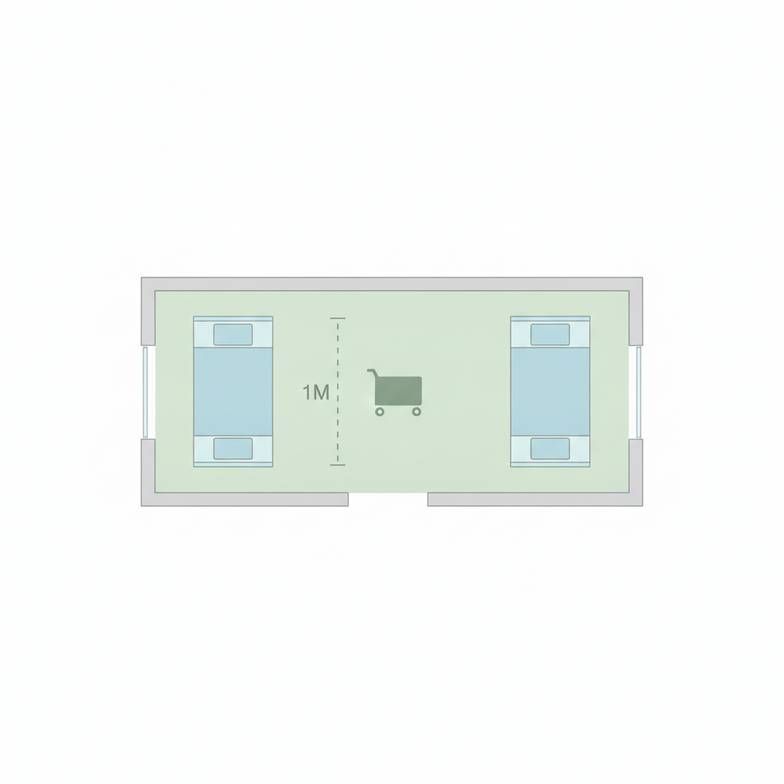
Instead of just placing bed footprints on a floor plan, think in terms of "functional zones." A safe starting point for planning is to allow at least 1 meter of clear space:
- Between each bed.
- Between the foot of the bed and the opposing wall.
- On at least one side of the bed next to a wall.
This clearance isn't empty space; it's necessary for workflow. It allows staff to move freely, bring in medical trolleys, operate patient lifts, open room and wardrobe doors without obstruction, and respond effectively in an emergency.
A bed with a lower unit price but a larger overall footprint might force you to reduce a room's capacity from four beds to three. In this scenario, the "cheaper" bed becomes the more expensive choice in the long run, as it permanently reduces your facility's revenue-generating potential.
Buyer Mistake vs. Supplier Check: A Hospital Bed Dimension Checklist
Use this checklist to move beyond ambiguous "standard sizes" and ask suppliers the right questions. This helps you compare quotations on an equal, practical basis.
| Common Buyer Assumption | The Hidden Risk | The Smart Question to Ask Your Supplier |
|---|---|---|
| "A standard size is enough for a quote." | Beds are delivered and are physically too large for the rooms. | "Can you provide a technical drawing with both the mattress platform and overall bed dimensions clearly labeled?" |
| "The mattress will fit." | Unsafe gaps pose an entrapment risk, or a thick mattress can make side rails less effective. | "What is the recommended mattress height range for this bed to support side rail safety?" |
| "The room can fit four beds." | The layout is cramped, inefficient, and may not meet local guidelines or facility protocols. | "What is the minimum operational clearance you recommend around this bed for staff access and lowering side rails?" |
| "The cheaper bed is the better deal." | The cheaper bed has a wider frame, which reduces total ward capacity and long-term revenue. | "What is the overall width of this bed frame? I need to compare its true space impact against other models." |
| "The bed will work with our equipment." | Existing patient lifts or overbed tables don't fit under the new bed frame. | "What is the under-bed clearance height? I need to confirm it's compatible with our mobile equipment." |
Preparing Your Inquiry: What to Send a Supplier for an Accurate Plan
Vague inquiries lead to vague quotations. To get a useful plan and an accurate price, a good supplier needs more than just a product name and quantity. Taking the time to prepare these details will help you avoid procurement failures.
For the most effective consultation, please prepare and send:
1. A simple layout of a typical room, including dimensions and the number of beds desired per room. 2. The exact dimensions (Length x Width x Height) of the mattresses you plan to use. 3. Your facility's required clearance space between beds and from beds to walls, if known from your project consultant or local guidelines. 4. A list of any important mobile equipment, such as specific models of patient lifts or overbed tables, with their required under-bed clearance height.
Sending this complete package of information allows us to act as a project partner, helping you develop a functional, space-efficient plan for your facility, not just a simple price list.
Written by
CareFurnex Team
CareFurnex Team shares practical knowledge about hospital beds, patient room furniture, medical trolleys, clinic furniture, and healthcare facility procurement for international B2B buyers.
Related Products
Hospital Mattresses
Medical bed mattresses for hospital beds, nursing beds, and patient room use.
View product
Hospital Beds
General-purpose patient beds for inpatient wards and standard hospital rooms.
View productElectric Hospital Beds
Motorized multi-function beds with electric height, backrest, and leg adjustment options.
View product